

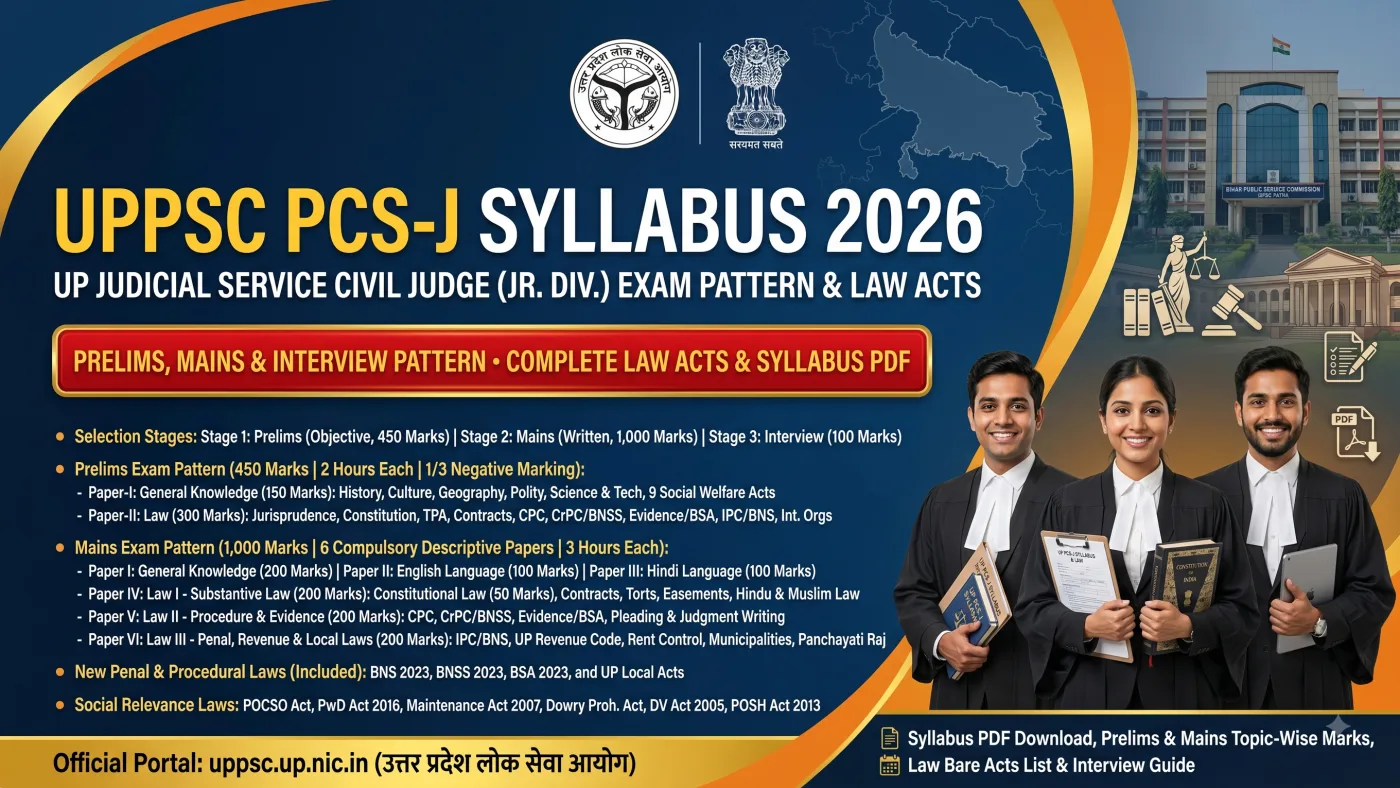
The Uttar Pradesh Public Service Commission (UPPSC) has published the UPPSC PCS-J Syllabus 2026 with Advertisement No. A-6/E-1/2026 (20 November 2026) for the U.P. Judicial Service Civil Judge (Junior Division) Examination, 2026, which has 365 posts. Appendix-2 sets out three stages: an objective Prelims of 450 marks, a written Mains of 1,000 marks, and a 100-mark interview. Appendix-3 lists the Acts covered in each paper. Online forms close on 21 December 2026.
Quick Summary (एक नज़र में)
| Item | Details |
|---|---|
| Exam | U.P. Judicial Service Civil Judge (Junior Division) Examination, 2026 (UPPSC PCS-J) |
| Advertisement | A-6/E-1/2026, dated 20 November 2026 · 365 posts · Pay Level-10 (₹77,840–1,36,520) |
| Stages | Preliminary (objective, MCQ) → Main (written, conventional) → Viva-voce (Personality Test) |
| Prelims | Paper I General Knowledge 150 marks + Paper II Law 300 marks · 2 hours each |
| Negative marking (नकारात्मक अंकन) | Prelims only: one-third (0.33) of the question's marks cut for each wrong answer |
| Mains | 6 papers, 3 hours each, 1,000 marks (GK 200, English 100, Hindi 100, three Law papers 200 each) |
| Interview | 100 marks |
| Final merit | Mains + Interview = 1,100 marks (Prelims marks are not added) |
| Medium | GK and Law papers in Hindi or English, as you choose |
| Minimum efficiency standard | 40% (General and other categories) · 35% (SC, ST and PwBD) |
UPPSC PCS-J Exam Pattern 2026: Three Stages at a Glance
Appendix-2 of the advertisement lays out the plan of the exam. The Prelims only screens candidates for the Mains. Your place in the final list depends on your Mains written marks plus your interview marks.
| Stage | Type | Marks | Counted in final merit? |
|---|---|---|---|
| Preliminary Examination | Objective, multiple choice (OMR) | 450 | No (screening only) |
| Main (Written) Examination | Conventional, descriptive | 1,000 | Yes |
| Viva-voce (Personality Test) | Interview | 100 | Yes |
Shortlisting ratios are fixed by order of the Supreme Court: 1:10 from Prelims to Mains and 1:3 from Mains to interview, measured against the vacancies. With 365 posts, that means roughly 3,650 candidates in the Mains and about 1,095 in interviews. The exact numbers depend on how each category's vacancies are counted.
Prelims Pattern: GK 150 Marks and Law 300 Marks
| Paper | Subject | Time | Maximum Marks |
|---|---|---|---|
| Paper I | General Knowledge | 2 hours | 150 |
| Paper II | Law | 2 hours | 300 |
| Total | 450 | ||
The Law paper is worth two-thirds of the Prelims. The advertisement does not say how many questions each paper has, so do not rely on question counts shared on social media until the question booklet confirms them.
How Negative Marking Works in the PCS-J Prelims
- Each question has four options.
- For a wrong answer, one-third (0.33) of the marks for that question is deducted.
- If you mark more than one option, it counts as wrong, even if one of them is correct. The same penalty applies.
- A question left blank carries no penalty.
In practice, three wrong answers wipe out the marks of one correct answer. Guess only when you can rule out at least two options.
OMR Rules From the Advertisement
- Use only a black ballpoint pen. Any other pen or a pencil is not allowed.
- No whitener, blade, pin or rubber on the sheet. Circles that are not darkened properly can make the OMR sheet invalid.
- The OMR sheet has three copies: Pink (original), Green (preserved) and Blue (candidate's copy). You take the Blue copy home. Keep it safe to check your answers against the answer key.
Prelims Law Paper Syllabus: 10 Subjects Named in Appendix-3
Appendix-3 says Paper II will also include "day to day happenings around India and the world, particularly in Legal spheres, Acts and laws". Recent judgments and new legislation are therefore part of the Law paper, not just the GK paper.
| No. | Subject / Act |
|---|---|
| (i) | Jurisprudence |
| (ii) | International Organisations |
| (iii) | Current International Affairs |
| (iv) | Indian Constitution |
| (v) | Transfer of Property Act |
| (vi) | Indian Evidence Act, 1872 and Bharatiya Sakshya Adhiniyam, 2023 |
| (vii) | Indian Penal Code, 1860 and Bharatiya Nyaya Sanhita, 2023 |
| (viii) | Civil Procedure Code |
| (ix) | Criminal Procedure Code, 1973 and Bharatiya Nagarik Suraksha Sanhita, 2023 |
| (x) | Law of Contract |
General Knowledge Syllabus (Same for Prelims Paper I and Mains Paper 1)
The GK text in Appendix-3 is identical for both stages. Only the format changes: MCQs in the Prelims, written answers in the Mains. The commission says the questions should be answerable by "a well educated person … without any specialized study".
General areas: History of India and Indian Culture, Geography of India, Indian Polity, Current National Issues, India and the World, Indian Economy, International Affairs and Institutions, and developments in Science and Technology, Communications and Space.
Social-welfare laws named in the GK syllabus. These fall under "sensitivity to persons with disabilities, senior citizens and offences on women and children". General candidates often skip them, but they are listed by name:
| Act | Year |
|---|---|
| Rights of Persons with Disabilities Act | 2016 |
| Maintenance and Welfare of Parents and Senior Citizens Act | 2007 |
| Dowry Prohibition Act | 1961 |
| Protection of Women from Domestic Violence Act | 2005 |
| Sexual Harassment of Women at Workplace (Prevention, Prohibition and Redressal) Act | 2013 |
| Pre-Conception and Pre-natal Diagnostic Techniques (Prohibition of Sex Selection) Act | 1994 |
| Medical Termination of Pregnancy Act | 1971 |
| Indecent Representation of Women (Prohibition) Act | 1986 |
| Protection of Children from Sexual Offences (POCSO) Act | 2012 |
The syllabus asks for the "salient features" of these Acts: their purpose, key definitions, offences, penalties and the authorities they set up. A short note on each Act serves you twice, once for the Prelims MCQs and again for the Mains GK paper.
UPPSC PCS-J Mains Exam Pattern 2026: Six Papers, 1,000 Marks
| Paper | Subject | Time | Marks |
|---|---|---|---|
| Paper 1 | General Knowledge | 3 hours | 200 |
| Paper 2 | English Language | 3 hours | 100 |
| Paper 3 | Hindi Language (हिंदी भाषा) | 3 hours | 100 |
| Paper 4 | Law-I (Substantive Law) | 3 hours | 200 |
| Paper 5 | Law-II (Procedure and Evidence) | 3 hours | 200 |
| Paper 6 | Law-III (Penal, Revenue and Local Laws) | 3 hours | 200 |
| Written total | 1,000 | ||
| Interview | Viva-voce | – | 100 |
The three Law papers make up 600 of the 1,000 written marks. The advertisement also says the commission may refuse an interview call to any candidate whose Law paper marks do not justify one. A good GK and language score cannot make up for weak Law papers.
English and Hindi Language Papers: The Translation Is Reversed
| Question | Paper 2 – English (100) | Paper 3 – Hindi (100) |
|---|---|---|
| Essay | 50 marks | 50 marks |
| Précis writing | 30 marks | 30 marks |
| Translation | Hindi passage → English (20 marks) | English passage → Hindi (20 marks) |
The language papers are written in their own language. The Hindi-or-English choice of medium applies only to the GK and Law papers. The advertisement also requires "a thorough knowledge of Hindi in Devanagari script" as an eligibility condition, so expect the Hindi paper to be marked strictly. Practise précis to about one-third of the passage's length and keep an eye on the clock. Each language paper has only three questions to fill three hours, so presentation matters.
Mains Law Papers: Acts and Mark Splits From Appendix-3
Paper 4 – Law-I (Substantive Law), 200 Marks
| Area | What the syllabus covers |
|---|---|
| Contract and Partnership | Law of contracts, law of partnership |
| Easements and Torts | Law concerning easements and torts |
| Transfer of Property | Law of transfer of property, including the principles of equity that apply to it |
| Equity, Trusts and Specific Relief | Principles of equity, with special reference to the law of trust and specific relief |
| Personal Laws | Hindu Law and Mohammedan Law |
| Constitutional Law | Fixed 50 marks of questions on Constitutional Law alone |
Paper 5 – Law-II (Procedure and Evidence), 200 Marks
| Area | What the syllabus covers |
|---|---|
| Evidence | Indian Evidence Act, 1872 and Bharatiya Sakshya Adhiniyam, 2023 |
| Criminal Procedure | Criminal Procedure Code, 1973 and Bharatiya Nagarik Suraksha Sanhita, 2023 |
| Civil Procedure | Code of Civil Procedure, including the principles of pleading |
| Practical focus (stated in the syllabus) | Framing of charges and issues, dealing with the evidence of witnesses, writing of judgments and the conduct of cases generally |
The syllabus says this paper will relate "mainly to practical matters". Expect fact-based problems where you frame issues in a civil suit, frame a charge in a criminal case, or write a short judgment. Reading bare provisions alone will not be enough for this paper.
Paper 6 – Law-III (Penal, Revenue and Local Laws), 200 Marks
| Part | Acts listed | Marks |
|---|---|---|
| Penal Laws | Indian Penal Code, 1860 · Bharatiya Nyaya Sanhita, 2023 | 50 |
| Revenue and Local Laws (compulsory) | Uttar Pradesh Revenue Code, 2006 · U.P. Urban Buildings (Regulation of Letting, Rent and Eviction) Act, 1972 · U.P. Regulation of Urban Premises Tenancy Act, 2021 · U.P. Municipalities Act · U.P. Panchayat Raj Act · U.P. Consolidation of Holdings Act · U.P. Urban Planning and Development Act, 1973, together with the rules framed under these Acts | 150 |
Answers to the Local Laws questions are compulsory. The rules made under each Act are part of the syllabus as well.
Where the Marks Are: Preparation Pointers for PCS-J 2026
- U.P. local and revenue laws are worth 150 marks. That is the largest single block in the Mains, and candidates from other states usually know these Acts least. Make the U.P. Revenue Code, 2006 and the two rent/tenancy laws (the 1972 Act and the 2021 Act) your base, then cover the Panchayat Raj, Municipalities, Consolidation and Urban Planning Acts.
- Old and new criminal laws are both in the syllabus. IPC and BNS, CrPC and BNSS, and the Evidence Act and BSA are all named, in both the Prelims and the Mains. Keep a section-correspondence chart (old section → new section) and learn the main changes in the new codes.
- Constitutional Law has a guaranteed 50 marks in Paper 4 and also appears in the Prelims Law paper as "Indian Constitution". Study it once at Mains depth and it covers both.
- Penal law in the Mains is worth only 50 marks, much less than its share in the Prelims. Do not let IPC/BNS take up your Mains time at the cost of the local laws.
- Practise judgment writing and framing issues and charges for Paper 5. Write at least one practice answer of each type every week.
- Jurisprudence, International Organisations and Current International Affairs appear only in the Prelims Law paper. Plan short, fact-based revision for these three.
- Revise the social-welfare Acts in the GK syllabus (POCSO, PWDV, POSH, RPwD, PCPNDT and others). They are useful in both GK papers.
Qualifying Marks: Worked Example of the 40% / 35% Rule
The advertisement sets a minimum efficiency standard (न्यूनतम दक्षता मानक). Candidates who score below it in the Preliminary or Main examination are not placed in the merit or select list. Applied to the full marks of each stage, it works out as follows:
| Category | Standard | Prelims (out of 450) | Mains (out of 1,000) |
|---|---|---|---|
| Unreserved, OBC, EWS and other categories | 40% | 180 | 400 |
| SC, ST and Persons with Benchmark Disabilities | 35% | 157.5 | 350 |
This is only the minimum floor. The real cut-off depends on the 1:10 and 1:3 ratios and on how candidates perform. UPPSC has not published any cut-off for this cycle, so plan for a score well above these figures.
Interview: 100 Marks
The interview tests a candidate's suitability for the U.P. Judicial Service "with reference to his merit giving due regard to his ability, character, personality and physique". Interview marks are added to the Mains written marks, and the final rank is based on the total out of 1,100. Before the interview you fill a separate form. All original certificates are checked at the interview, so carry four passport-size photographs (two attested) and, if you are in government service, a No Objection Certificate.
How to Download the UPPSC PCS-J Syllabus 2026 PDF
The syllabus is not a separate file. It is printed as Appendix-2 (plan of exam) and Appendix-3 (syllabus) at the end of the detailed advertisement.
- Open the UPPSC notifications page: uppsc.up.nic.in → "All Notifications / Advertisements" (link in the box below).
- Find "U.P. Judicial Service Civil Judge (Junior Division) Examination, 2026" (Advt. No. A-6/E-1/2026).
- Click "View Advertisement". The full advertisement opens in your browser session.
- Scroll to the last page, Page 6, for Appendix-2 and Appendix-3. Save or print the PDF.
- If you have not applied yet, use the same page to click "Apply". You will need your OTR number from otr.pariksha.nic.in. The last date for fee payment and form submission is 21 December 2026.
The PDF opens only through the notifications page, so a direct download link copied from someone else may not work.
Eligibility in Brief (Check Before You Start Preparing)
Under the transitional rules that follow the Supreme Court's judgment of 21 August 2026 (Bhumika Trust vs. Union of India), candidates need:
- an LL.B. degree;
- enrolment as an advocate;
- at least one year of legal practice as on the date of the advertisement;
- thorough knowledge of Hindi in Devanagari script.
The age limit is 22–35 years as on 1 July 2027, and a candidate is allowed a maximum of four attempts. Fees, vacancies by category, age relaxation and the practice-certificate rule are explained in our UPPSC PCS-J Recruitment 2026 post.
For comparison with other state exams, see the RPSC RAS Syllabus 2026. If you are also preparing for teaching exams in the state, read the UPTET Syllabus 2026. More updates are on our Uttar Pradesh jobs page and in the syllabus and exam pattern section.
Source: Official advertisement Advt. No. A-6/E-1/2026 dated 20 November 2026 (Appendix-2: Plan of Examination; Appendix-3: Syllabus), Uttar Pradesh Public Service Commission, uppsc.up.nic.in. Last verified: 29 November 2026.
User Discussion & Comments (0)
No comments yet. Be the first to leave a comment below!
Leave a Comment / Ask a Question: