

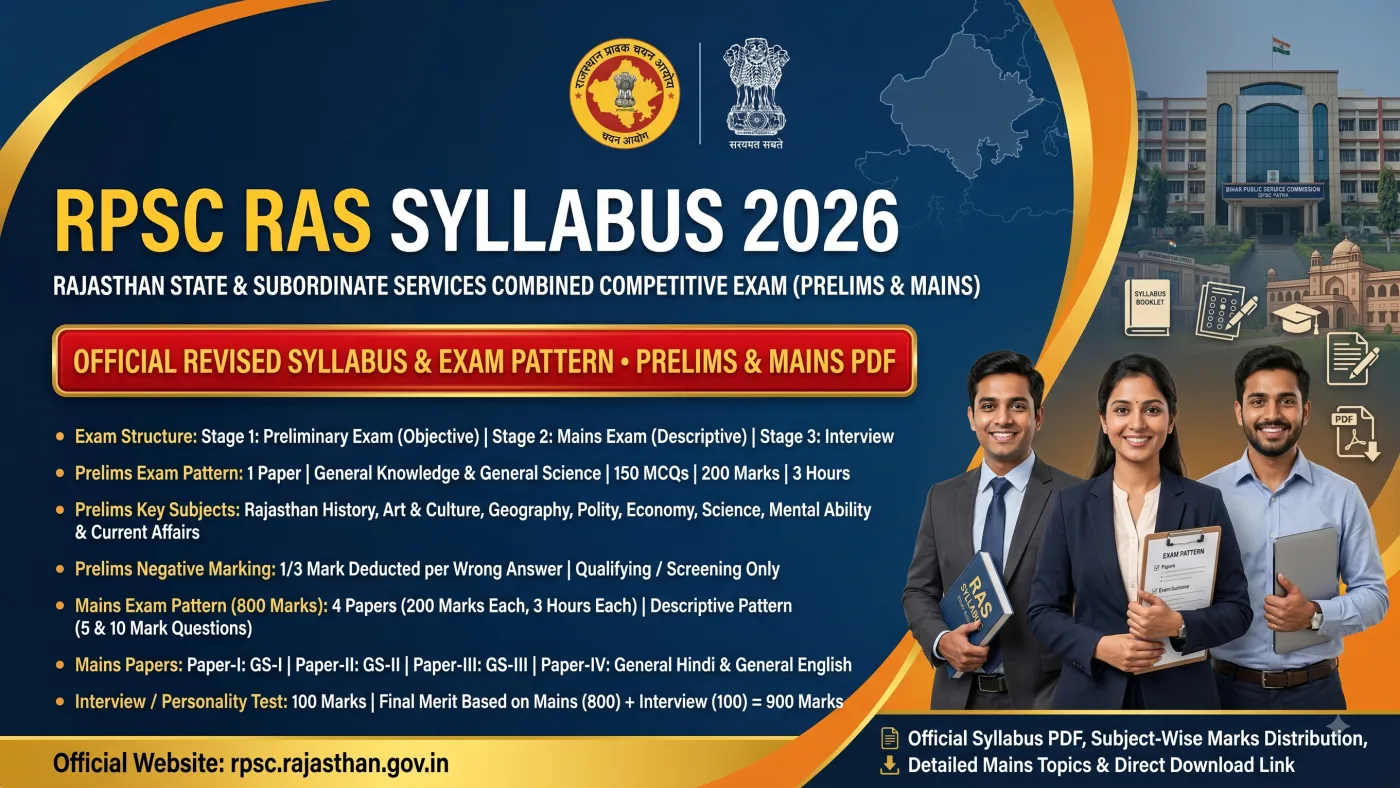
The Rajasthan Public Service Commission (RPSC), Ajmer has published the RPSC RAS Syllabus 2026 for the Rajasthan State and Subordinate Services Combined Competitive Exam. The scheme and syllabus are dated 09 January 2026 and apply to Advt. No. 02/Pariksha/RAS&RTS/RPSC/EP-I/2026-27 (607 posts). The Prelims is on 06 December 2026. As per the RPSC schedule, the Mains is set for 01–02 May 2027.
Quick Summary (एक नज़र में)
| Item | Details |
|---|---|
| Exam stages | Preliminary (objective) → Mains (4 descriptive papers) → Interview |
| Prelims paper | General Knowledge and General Science – 150 questions, 200 marks, 3 hours |
| Negative marking | 1/3 mark for each wrong answer |
| 5th option (पाँचवाँ विकल्प) | Darken circle '5' for a question you skip; 10 minutes extra are given for this |
| Prelims marks in final merit | Not counted – screening test only |
| Mains | 4 papers × 200 marks = 800 marks, 3 hours each |
| Interview | 100 marks |
| Final merit | Mains (800) + Interview (100) = 900 marks |
| Prelims exam date | 06 December 2026, 12:00 PM to 3:00 PM |
| Mains (as per RPSC schedule) | 01–02 May 2027 |
RAS Prelims 2026 Exam Pattern: One Paper, 150 Questions
The Prelims has a single objective paper of Bachelor's Degree standard. RPSC's own scheme says it is "meant to serve as a screening test only". It decides who goes to the Mains. It does not decide your final rank.
| Subject | Questions | Maximum Marks | Time |
|---|---|---|---|
| General Knowledge and General Science | 150 (multiple choice, equal marks) | 200 | 3 Hours |
The official syllabus does not fix how many questions come from each topic. So there is no official subject-wise weightage. Any "topic-wise marks" chart you see elsewhere is a guess.
The 5th Option Rule on the OMR Sheet
The advertisement gives special instructions for the OMR answer sheet. In simple words:
- Every question has five options, numbered 1, 2, 3, 4 and 5. You darken one circle with a blue ball point pen.
- Choosing one option for every question is mandatory.
- If you do not want to answer a question, darken circle '5'.
- If none of the five circles is darkened, one third (1/3) of the marks of that question is deducted.
- If you leave more than 10% of the questions with no circle darkened, you will be disqualified.
- Before handing over the sheet, check that you have darkened one circle for each question. Extra time of 10 minutes is given for this.
Worked example: 10% of 150 questions is 15. If you leave 16 or more questions fully blank (no circle at all), your sheet is liable to be disqualified. Skipping is allowed – but skip by darkening '5', not by leaving the row empty.
The RPSC press note of 26 November 2026 repeats that 10 minutes of extra time will be given on 06 December to fill the 5th option. Entry to the centre closes 60 minutes before the exam starts. Admit card details are in our RPSC RAS Admit Card 2026 post.
RAS Prelims Syllabus 2026: Topic Table
This table follows the headings of the official English syllabus dated 09 January 2026. The Hindi version (हिंदी सिलेबस) has the same topics.
| Section | Topics in the official syllabus |
|---|---|
| History, Art, Culture, Literature, Tradition & Heritage of Rajasthan | Pre-historic sites (Palaeolithic to Chalcolithic and Bronze Age); sources of Rajasthan history (archaeological, archival, literary, numismatic); prominent rulers and dynasties, cooperation and resistance with central power; medieval administrative and revenue system; 18th–19th century conditions, peasant and tribal movements, Praja Mandal movements, integration of Rajasthan; temples, forts, palaces, waterbodies, painting schools, handicrafts, folk dance, drama, music and instruments; Rajasthani dialects and literature; saints, sects and folk deities; fairs, festivals, customs, attire and ornaments; leading personalities |
| Indian History | Indus and Vedic age; Ajivakas, Buddhism, Jainism; Maurya, Kushan, Satavahan, Gupta, Chalukya, Pallava, Chola; Indian Knowledge and Value System (Varna Ashram, Purushartha, Sanskara); Sultanate, Vijaynagar, Mughals, Marathas; Bhakti and Sufi movements; British imperialism and resistance, Revolt of 1857, freedom struggle; nation building up to 2000 |
| Geography of World and India | World: mountains, plateaus, plains, deserts, rivers, vegetation, agriculture, industrial regions, transport, environmental issues (desertification, climate change, ozone depletion). India: physiographic divisions, climate, rivers and lakes, irrigation, crops, metallic and non-metallic minerals, industrial regions |
| Geography of Rajasthan | Location and physiography, rivers and lakes, climate, vegetation and biodiversity, soil, agriculture, livestock, irrigation, population (growth, density, literacy, sex ratio), urbanisation, tribes, minerals, tourism |
| Indian Constitution, Political System & Governance | Framing of the Constitution, Preamble, citizenship, Fundamental Rights, DPSP, Fundamental Duties; Union executive, legislature, judiciary; Centre-State relations, emergency provisions; local government; Election Commission, UPSC, NHRC, NCW, NCPCR, NITI Aayog; citizen charter, social audit; Lokpal, CVC, CIC |
| Political and Administrative System of Rajasthan | Governor, CM and Council of Ministers, Assembly, High Court; Chief Secretary, Divisional Commissioner, Collector, SP, SDO, Tehsildar; RPSC, State Election Commission, State Information Commission, State Women Commission, Board of Revenue, Lokayukt; Panchayati Raj and municipalities |
| Economic Concepts and Indian Economy | Growth and development, HDI; monetary and fiscal policy; recent Union Budget; Finance Commission and fiscal federalism; agriculture reforms; industrial policy and LPG reforms; service sector; skill development, employment, social justice |
| Economy of Rajasthan | State budget and macro overview; agriculture, industry and services; energy, transport, communication; rural development and State Finance Commission; education and health; major welfare schemes of the Government of Rajasthan |
| Science & Technology | Everyday science; computers and ICT; defence and space technology; genetics, biotechnology, nanotechnology; health, nutrition, diseases; environment and biodiversity; agriculture, horticulture, forestry and animal husbandry with reference to Rajasthan; S&T programmes of Rajasthan and India; recent advancements |
| Reasoning & Mental Ability | Statement-based reasoning (assumptions, arguments, conclusions, courses of action), analytical reasoning; number/letter series, coding-decoding, relations, direction sense, Venn diagrams, ranking and seating; basic numeracy (ratio, profit-loss, percentage, interest, area, data analysis, mean/median/mode, permutation-combination, simple probability) |
| Current Affairs & Issues (with special reference to Rajasthan) | Personalities, places and contemporary issues; new welfare schemes; economic and political developments; sports; awards and books; Rajasthan Public Examination (Measures for Prevention of Unfair Means in Recruitment) Act, 2022 |
Note the last line: the 2022 anti-cheating Act is listed by name in the current affairs section, so expect a question on it. The same Act is quoted in the RPSC press note – using unfair means can lead to life imprisonment and a fine of up to ₹10 crore.
Who Reaches the Mains: The "15 Times" Rule
The Mains syllabus says the number of candidates admitted to the Mains will be 15 times the approximate number of vacancies. All candidates who get the same marks as the last cut-off score are also admitted.
Rough example: the advertisement lists 607 posts (State Services 192, Subordinate Services 415). 607 × 15 = about 9,105 candidates. The real figure can differ, because the number of posts may be revised and tied candidates are added. Separate calculation is also done for reserved categories, as explained in the advertisement.
RAS Mains Exam Pattern 2027: Four Papers, 800 Marks
All four Mains papers are descriptive/analytical, with brief, medium, long answer and descriptive questions. The General Hindi and General English standard is Senior Secondary level.
| Paper | Subject | Marks | Time |
|---|---|---|---|
| Paper I | General Studies-I | 200 | 3 Hours |
| Paper II | General Studies-II | 200 | 3 Hours |
| Paper III | General Studies-III | 200 | 3 Hours |
| Paper IV | General Hindi and General English | 200 | 3 Hours |
| Written total | 800 | ||
| Personality and Viva-Voce (Interview) | 100 | – | |
Question Count and Word Limits per Paper
RPSC has also published a separate marks scheme for the Mains. It shows 34 questions in each of Papers I, II and III, with only two answer lengths – 50 words (5 marks) and 150 words (10 marks).
| Paper / Unit | 5-mark questions (50 words) | 10-mark questions (150 words) | Unit total |
|---|---|---|---|
| Paper I – Unit I (History) | 8 (40 marks) | 3 (30 marks) | 70 |
| Paper I – Unit II (Economics) | 6 (30 marks) | 3 (30 marks) | 60 |
| Paper I – Unit III (Sociology, Management, Accounting & Auditing) | 14 (70 marks) | – | 70 |
| Paper II – Unit I (Administrative Ethics) | 7 (35 marks) | 3 (30 marks) | 65 |
| Paper II – Unit II (General Science & Technology) | 14 (70 marks) | – | 70 |
| Paper II – Unit III (Earth Science) | 7 (35 marks) | 3 (30 marks) | 65 |
| Paper III – Unit I (Polity, International Affairs, Current Affairs) | 11 (55 marks) | 3 (30 marks) | 85 |
| Paper III – Unit II (Public Administration) | 6 (30 marks) | 3 (30 marks) | 60 |
| Paper III – Unit III (Behavior and Law) | 11 (55 marks) | – | 55 |
| Paper IV – Unit I (सामान्य हिंदी) | 3 parts of 30 marks each | 90 | |
| Paper IV – Unit II (General English) | Grammar 20 + Comprehension, Translation & Precis 30 + Composition & Letter 20 | 70 | |
| Paper IV – Unit III (Essay) | One essay of about 600 words, in Hindi or English | 40 | |
RPSC adds a note that this scheme is "only for general guidance" and the unit-wise marks and questions may vary. Treat it as a planning tool, not a promise.
RAS Mains Syllabus: What Each Paper Covers
Paper I – General Studies-I
- Unit I – History: Part A Rajasthan (history up to the 18th century, revenue system, 1857 and later movements, integration, art, fairs, tribes, heritage sites, Rajasthani literature, folk deities); Part B Indian History & Culture (heritage from Indus to British era, national movement, reform movements, post-independence India); Part C History of Modern World up to 1991 (Renaissance, American, French, Industrial and Russian revolutions, Nazism and Fascism, World Wars, Cold War).
- Unit II – Economics: Part A Indian Economy (agriculture, industry, MSME, trade, Union Budget, RBI, banking reforms, social sector); Part B World Economy (WTO, World Bank, IMF); Part C Economy of Rajasthan (SDP and per capita income, Viksit Rajasthan 2047, State Budget, irrigation, investment promotion policy, petroleum resources, PPP projects, welfare schemes).
- Unit III – Sociology, Management, Accounting & Auditing: caste and class, Karma, Dharma and Ashram concepts, cyber crime and social media; management functions, MBO, organisational behaviour, marketing, HRM, strategic management; GAAPs, accounting standards, financial statements, GST basics, government audit.
Paper II – General Studies-II
- Unit I – Administrative Ethics: values from great leaders, Rit and Rin, Karmavada, ethics of the Bhagwad Geeta, Gandhian ethics, AI versus conscience in administrative decisions, and non-factual case studies.
- Unit II – General Science & Technology: chemistry and physics in everyday life, cell and human physiology, GMOs, vaccines, CRISPR and mRNA technology, AI and machine learning, blockchain, cloud computing, cyber security, space programme, missiles and drone technology.
- Unit III – Earth Science (Geography & Geology): world (interior of the earth, earthquakes, climate), India (physiography, monsoon, resources, population) and Rajasthan (rivers, soils, minerals, tribes, UNESCO Geo-parks and geo-heritage sites, tourism).
Paper III – General Studies-III
- Unit I – Indian Polity, Governance, International and Current Affairs: Basic Structure doctrine, federalism, e-Courts, electoral reforms, internal security, Rajasthan politics and e-governance, India's foreign policy (UN, BRICS, G-20, QUAD, I2U2, Mission LiFE), current affairs and the role of Yoga.
- Unit II – Public Administration: theories and principles, New Public Management, Good Governance, and district administration (Collector, law and order, revenue and development administration).
- Unit III – Behavior and Law: intelligence types, leadership, workplace communication, stress and burnout; and a long list of laws with exact sections.
The law part is section-specific, which helps you study only what is asked. It includes the RTI Act 2005 (Sections 1–20), the IT Act 2000 (selected sections such as 65–67 and 71–78), the Domestic Violence Act 2005, the POSH Act 2013, POCSO 2012 (Sections 1–15), the Senior Citizens Act 2007, the Rajasthan Tenancy Act 1955, the Rajasthan Land Revenue Act 1956, and selected sections of the Bharatiya Nyaya Sanhita 2023 and Bharatiya Nagarik Suraksha Sanhita 2023. Check the PDF for the exact section numbers before you start notes.
Paper IV – General Hindi and General English
- सामान्य हिंदी (90 marks): उपसर्ग-प्रत्यय, शब्द और वाक्य शुद्धि, मुहावरे-लोकोक्ति, पारिभाषिक शब्दावली; संक्षिप्तीकरण, पल्लवन, अंग्रेजी से हिंदी अनुवाद; कार्यालयी पत्र, अर्द्धशासकीय पत्र, अधिसूचना, परिपत्र, प्रेस विज्ञप्ति।
- General English (70 marks): prepositions, phrasal verbs and idioms, one-word substitution; a 300-word unseen passage with 5 questions and a 100-word precis; translation of five sentences from Hindi to English; elaboration of a theme (150 words) and an official/D.O. letter or report (150 words).
- Essay (40 marks): one essay of about 600 words, chosen from six themes – language and heritage; society and governance; science, environment and sustainable development; economy and agriculture; current affairs and disasters; and tourism and culture with reference to Rajasthan.
Mains Qualifying Marks, Language Rule and Interview
- Minimum marks: to be called for the interview, a candidate must get at least 10% marks in each Mains paper and 15% in aggregate. SC/ST candidates get a 5% relaxation in these minimums. Relaxation for ex-servicemen and persons with disabilities applies as per the rules named in the advertisement.
- Language: answer in Hindi or English unless a paper says otherwise. You cannot write a paper partly in Hindi and partly in English.
- Handwriting: if your handwriting is not easily legible, marks may be deducted. Credit is given for orderly and concise expression.
- Interview (100 marks): the board looks at character, personality, address, physique, and knowledge of Rajasthani culture. For the Rajasthan Police Service, an NCC 'C' certificate gets preference. Interview marks are added to the written marks to make the final merit.
How to Download the RPSC RAS Syllabus 2026 PDF
- Open the official website rpsc.rajasthan.gov.in.
- In the menu, open the Syllabus section (the full list of syllabus PDFs).
- Look for "RAJ. STATE AND SUB. SERVICES COMB. COMP EXAM - 2026". Entries dated 09 January 2026 are the current ones.
- Download the Prelims syllabus (English or Hindi), the Mains syllabus (English or Hindi) and the separate "Scheme for … (Mains) Exam" PDF that gives the marks per unit.
- The same page also lists the 2023 and 2024 RAS syllabus files. Use only the 2026 files dated 09 January 2026, so that your notes match this exam.
Direct links to all these PDFs are in the Important Links box below.
Practical Tips Built on the Official Syllabus
- Plan Prelims and Mains together. Rajasthan history, geography, economy, polity and science appear in both. The Mains then adds Sociology, Management, Accounting, Ethics, Public Administration, Behavior and Law, which need separate time.
- Practise the 50-word answer. 5-mark, 50-word questions make up most of Papers I–III (for example, 14 such questions in Paper I Unit III). Writing short, exact answers is the key skill.
- Use official question papers. RPSC publishes earlier RAS question papers on its website. The 2024 Prelims paper is linked below.
- Keep Rajasthan current affairs and schemes ready. Both the Prelims and Paper III list welfare schemes and initiatives of the Government of Rajasthan by name.
Other Rajasthan exam updates, such as the RSSB CET 12th Level Admit Card 2026, are on our Rajasthan jobs page. More exam patterns are listed under Syllabus.
Source: RPSC Scheme & Syllabus of the Rajasthan State and Subordinate Services Combined Competitive (Preliminary) and (Mains) Examination, dated 09 January 2026; RPSC Mains marks scheme dated 09 January 2026; Advt. No. 02/Pariksha/RAS&RTS/RPSC/EP-I/2026-27 dated 27 May 2026; RPSC Press Note dated 26 November 2026 – rpsc.rajasthan.gov.in. Mains date as per the RPSC exam schedule. Last verified: 28 November 2026.
User Discussion & Comments (0)
No comments yet. Be the first to leave a comment below!
Leave a Comment / Ask a Question: