

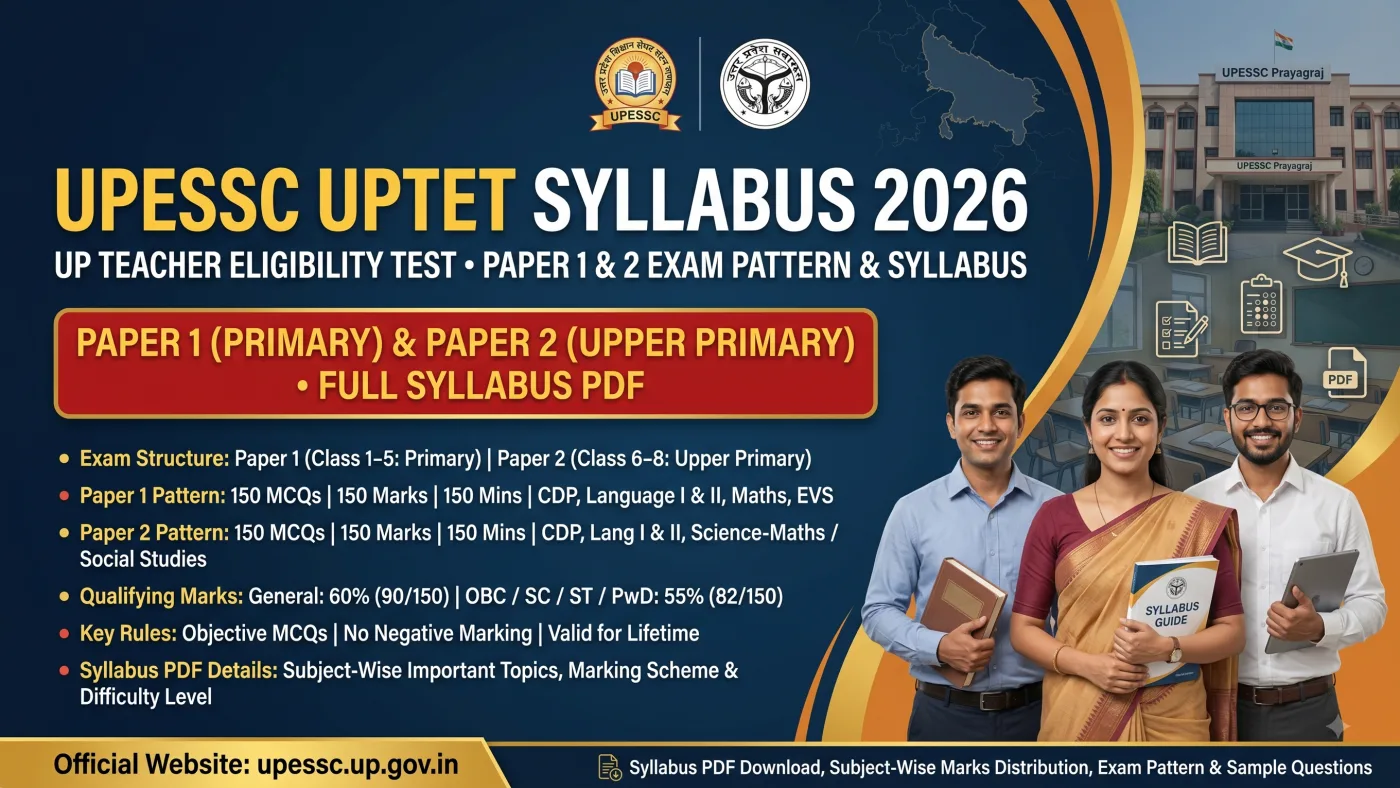
The Uttar Pradesh Education Service Selection Commission (UPESSC) has published the official UPTET Syllabus 2026 for both levels of the Uttar Pradesh Teacher Eligibility Test under Advertisement No. 10/2026: Paper 1 (Primary, Classes 1 to 5) and Paper 2 (Upper Primary, Classes 6 to 8). Each paper has 150 one-mark MCQs in 150 minutes with no negative marking. The exam is scheduled for 26 and 27 February 2027.
Quick Summary (एक नज़र में)
| Item | Details |
|---|---|
| Exam | Uttar Pradesh Teacher Eligibility Test (UPTET) 2026, Advt. No. 10/2026 |
| Conducting body | Uttar Pradesh Education Service Selection Commission (UPESSC), Prayagraj |
| Papers | Paper 1: Primary level (Classes 1–5) · Paper 2: Upper Primary level (Classes 6–8) |
| Questions and marks | 150 MCQs, 150 marks per paper (1 mark each, 4 options) |
| Duration | 2 hours 30 minutes (150 minutes) |
| Negative marking (नकारात्मक मूल्यांकन) | None |
| Medium | Hindi and English (except the language sections) |
| Qualifying marks (अर्हक अंक) | General: 90/150 (60%) · SC/ST/OBC/EWS and other listed categories: 82/150 (55%) |
| Exam date | 26 and 27 February 2027 |
| Last date for online fee payment | 23 December 2026 (correction till 27 December 2026) |
Registration is open now. Dates, fee and step-by-step form filling are covered in our UPTET 2026 Online Form post.
UPTET 2026 Exam Pattern: Paper 1 vs Paper 2
Both papers share the same frame: 150 questions, 150 marks, 150 minutes, OMR-based, and no marks cut for a wrong answer. The difference is in the fourth and fifth blocks.
Paper 1 (Primary Level, Classes 1–5)
| Section | Questions | Marks |
|---|---|---|
| Child Development and Teaching Methods (बाल विकास एवं शिक्षण विधि) | 30 | 30 |
| Language 1: Hindi (भाषा प्रथम) | 30 | 30 |
| Language 2: English / Urdu / Sanskrit (any one) | 30 | 30 |
| Mathematics (गणित) | 30 | 30 |
| Environmental Studies (पर्यावरणीय अध्ययन) | 30 | 30 |
| Total | 150 | 150 |
Paper 2 (Upper Primary Level, Classes 6–8)
| Section | Questions | Marks |
|---|---|---|
| Child Development and Teaching Methods | 30 | 30 |
| Language 1: Hindi | 30 | 30 |
| Language 2: English / Urdu / Sanskrit (any one) | 30 | 30 |
| (a) Mathematics and Science – for Maths/Science teachers, or (b) Social Studies – for Social Studies/Social Science teachers (c) Any other teacher: choose (a) or (b) | 60 | 60 |
| Total | 150 | 150 |
Choose the 60-mark option carefully. A B.Sc. graduate who plans to teach Science must take Maths and Science; an Arts graduate aiming for a Social Studies post takes Social Studies. Teachers of other subjects (for example, Hindi or Sanskrit) may pick either one.
Qualifying Marks: How Many Marks You Need to Pass
UPTET is a pass/fail eligibility test. The advertisement fixes these minimums out of 150:
| Category | Minimum marks | Percentage |
|---|---|---|
| General | 90 | 60% |
| SC / ST / OBC / EWS / dependants of freedom fighters / ex-servicemen (self) / disabled | 82 | 55% |
Worked example: an OBC candidate from Uttar Pradesh who scores 84 qualifies, because the bar is 82. An OBC candidate from Bihar with the same 84 does not qualify. The advertisement says reserved-category candidates who are not natives of Uttar Pradesh are treated as General, so the Bihar candidate needs 90.
Normalisation: if the exam is held in a single shift, your raw score decides the result. If the commission holds it in more than one shift because of a high number of applications, scores will be normalised under the commission's notice dated 26 February 2026, and only the normalised score will count.
The UPTET certificate is valid for life from the result date and is issued electronically through DigiLocker. Your photo and category on it cannot be changed later, so check them in the form before you submit.
Child Development and Teaching Methods (30 Questions, Both Papers)
This block is nearly the same in Paper 1 and Paper 2. It has two parts: content, and learning and teaching (अधिगम और अध्यापन).
| Unit | Topics in the official syllabus |
|---|---|
| Child development (बाल विकास) | Meaning, need and scope; stages of development – physical, mental, emotional and language development; expression ability; creativity and creative ability; heredity and environment (family, social, school, mass media) as factors |
| Learning: meaning and theories | Factors that affect learning, effective learning methods; Thorndike's laws of learning; trial-and-error (Thorndike), classical conditioning (Pavlov), operant conditioning (Skinner), insight (Kohler), Piaget's theory, Vygotsky's theory; learning curve, its types, and the plateau in learning – causes and remedies |
| Teaching and teaching methods | Meaning and aims of teaching, communication, principles and maxims of teaching, teaching techniques, new approaches, micro-teaching and basic teaching skills |
| Inclusive education, guidance and counselling (समावेशी शिक्षा) | Identification and types of exclusion – deprived groups, language, religion, caste, region, colour, gender, physical ability (visually, hearing, speech/orthopaedically impaired), mental ability; TLM and tools to assess included children; special methods such as Braille; guidance and counselling – meaning, aims, types, methods |
| Agencies that support counselling | Manovigyanshala U.P. (Prayagraj), Mandaliya Manovigyan Kendra (division level), District Hospital, trained DIET mentors, supervision and inspection system, community and school committees, government and non-government organisations |
| Learning and teaching | How children think and learn; why children "fail" at school; basic processes of teaching and learning; learning as a social activity; the child as problem solver and "scientific investigator"; alternative conceptions of learning; children's "errors" as steps in learning; cognition and emotions; motivation and learning; personal and environmental factors |
The list of UP counselling agencies (Manovigyanshala, Mandaliya Manovigyan Kendra, DIET mentors) is specific to this state's syllabus. Central TET books usually skip it, so read it separately.
Language 1 Hindi (30 Questions)
Paper 1 Hindi tests the basics a Class 1–5 teacher uses daily. Paper 2 moves to fuller grammar and figures of speech. Both carry a pedagogy part, "भाषा विकास का अध्यापन".
| Paper 1 Hindi (Primary) | Paper 2 Hindi (Upper Primary) |
|---|---|
| Unseen passage (अपठित अनुच्छेद) | Unseen passage |
| Hindi alphabet – vowels and consonants; words with and without matras | Noun, pronoun, adjective and verb with their types |
| Difference between sounds श, स, ष, ब, व, ढ, ड, ङ, क्ष, छ, ण and न | Voice: कर्तृवाच्य, कर्मवाच्य, भाववाच्य |
| Anusvar, anunasik and chandrabindu; conjunct letters | All sounds, conjuncts, anusvar and chandrabindu; different forms of "र" |
| All types of matras; sentence formation | Sentence types – simple, compound, complex |
| Punctuation marks | Identification and use of punctuation |
| Antonyms, synonyms, rhyming and non-rhyming words, similar-sounding words | Synonyms, opposites, words with many meanings; alphabetical order; word pairs (शब्द युग्म) |
| Types of noun, pronoun, verb and adjective; number, gender and tense | Number, gender, tense; transitive and intransitive verbs; types of avyay |
| Suffix, prefix; tatsam, tadbhav and deshaj words | Prefix and suffix; tatsam, tadbhav, deshaj and foreign words |
| Proverbs and idioms | Idioms and proverbs |
| Sandhi – swar (दीर्घ, गुण, वृद्धि, यण्, अयादि), vyanjan and visarg | Sandhi and its types (swar, vyanjan, visarg) |
| Types of vachya, samas and alankar; works of poets and writers | Samas, samas vigrah and types; alankar – अनुप्रास, यमक, श्लेष, उपमा, रूपक, उत्प्रेक्षा, अतिशयोक्ति |
Language teaching part (both papers): learning and acquisition; principles of language teaching; role of listening and speaking; role of grammar; challenges of teaching language in a diverse classroom, language difficulties, errors and disorders; language skills; evaluating speaking, listening, reading and writing; teaching-learning material (textbook, multimedia, multilingual classroom resources); remedial teaching.
Language 2: English, Urdu or Sanskrit (30 Questions)
You answer only the language you choose. One point to note from the PDFs: the English and Urdu lists give only content topics, while Sanskrit also includes the language-teaching part listed under Hindi above.
English Syllabus
| Paper 1 English | Paper 2 English |
|---|---|
| Unseen passage | Unseen passage |
| Sentences: subject and predicate; kinds of sentences | Subject and predicate; negative and interrogative sentences |
| Parts of speech: kinds of noun, pronoun, adverb, adjective, verb, preposition, conjunction | Noun, pronoun, verb, adjective (with degrees), adverb, preposition and conjunction – each with its kinds; interjection; parts of speech |
| Tenses – present, past, future | Narration; phrasal verbs; use of somebody, nobody, anybody |
| Articles; punctuation; word formation | Punctuation; suffix with root words; silent letters in words |
| Active and passive voice | Active and passive voice; use of request in sentences |
| Singular and plural; gender | Singular and plural; masculine and feminine gender; antonyms and synonyms; homophones |
Urdu Syllabus
- Both papers: unseen passage; technical language skills (ज़बान की फन्नी महारतें); lives and works of well-known writers and poets; idioms and proverbs (मुहावरे, ज़र्बुल अमसाल); figures of speech (सनअतें); correct spelling (इमला).
- Paper 1 adds: literary forms such as essay, short story, marsiya, masnavi and dastan with examples; pronunciation practice; ism, zameer, sifat, opposites, singular-plural and gender; social issues such as pollution, gender inequality, illiteracy and malnutrition; values in poems and stories.
- Paper 2 adds: hamd, ghazal, qasida, marsiya, masnavi and geet and the difference between them; Urdu's role in the country's shared culture; ism and its types, fe'l, tazkeer-o-taanees; erab; awareness of political, social and moral issues.
Sanskrit Syllabus
| Paper 1 Sanskrit | Paper 2 Sanskrit |
|---|---|
| Unseen passage | Unseen passage |
| Noun forms: अकारान्त (पुल्लिंग, स्त्रीलिंग, नपुंसकलिंग), ईकारान्त स्त्रीलिंग, उकारान्त पुल्लिंग, ऋकारान्त पुल्लिंग and स्त्रीलिंग | All case and number forms of अकारान्त, उकारान्त and ईकारान्त words in all three genders, and ऋकारान्त पुल्लिंग |
| Sanskrit names for home, family, surroundings, animals, birds, household items and body parts | Sarvanam, visheshan, dhatu, numbers |
| Pronoun, verbs, avyay, numbers | Avyay, samas, upsarg, pratyay, karak, vachya |
| Sandhi (deergh sandhi for simple words; swar, vyanjan, visarg); samas, upsarg, pratyay, karak, vachya; synonyms and antonyms | Sandhi (swar, vyanjan); synonyms, antonyms; alankar |
| Gender, number, pratyahar, types of vowels and consonants, anusvar; works of poets and writers | Use of gender, number and tense |
Paper 1 Mathematics (30 Questions)
| Content topics | Teaching issues (अध्यापन संबंधी मुद्दे) |
|---|---|
| Numbers and the four operations; LCM and HCF; fractions and decimals (add, subtract, multiply, divide); unitary method; percentage; profit and loss; simple interest | Nature of mathematical/logical thinking; understanding children's reasoning; place of maths in the curriculum; language of maths |
| Geometry – shapes and surfaces, angles, triangle, circle; money; measurement of time, weight, capacity, length and temperature | Community mathematics; evaluation through formal and informal methods |
| Perimeter of triangle, rectangle, square, quadrilateral; area of rectangle and square; volume and capacity of cube and cuboid | Problems of teaching; error analysis |
| Calendar; data, its presentation and representation; railway or bus timetable | Diagnostic and remedial teaching |
Railway/bus timetables and the calendar are named topics, so expect practical reading questions, not just arithmetic.
Paper 1 Environmental Studies (30 Questions)
EVS covers science, history, geography, civics and environment at the primary level.
| Content topics | Teaching issues |
|---|---|
| Family; food, health and hygiene; housing; plants and animals; our surroundings; fairs (मेला); local occupations; water; transport and communication; games and sportsmanship | Concept and scope of EVS; importance of integrated EVS; EVS and environmental education |
| India – rivers, mountains, plateaus, forests, transport, continents and oceans; Uttar Pradesh – rivers, mountains, plateaus, forests, transport | Learning principles; scope of and relation between science and social science |
| Constitution; governance – local self-government, gram panchayat, nagar panchayat, zila panchayat, nagar palika, nagar nigam, district administration, state government, legislature, judiciary, executive | Approaches to presenting concepts; activities; experiments/practical work; discussion |
| National festivals, national symbols, voting, national integration; environment – need, protection, social responsibility and schemes for environment protection | Continuous comprehensive evaluation (CCE); teaching material; problems |
Paper 2 Mathematics and Science (60 Questions)
Mathematics
- Natural, whole and rational numbers; integers, brackets, LCM and HCF; square root and cube root; exponents
- Algebra: variables and constants, powers, operations on algebraic expressions, terms and coefficients, like and unlike terms, degree; monomial, binomial and trinomial expressions; identities
- Simultaneous, quadratic and linear equations
- Parallel lines, triangles, construction of quadrilaterals; circle and cyclic quadrilateral; tangents to a circle; Cartesian plane; mensuration
- Commercial maths: ratio, proportion, percentage, profit and loss, simple and compound interest, tax, barter system; banking – current currency, bills and cash memo
- Statistics: classification of data, pictograph, mean, median, mode, frequency; pie and bar charts; probability; graphs and mixed bar diagrams
- Teaching issues: nature of logical thinking, place of maths in the curriculum, language of maths, community maths, evaluation, remedial teaching, problems of teaching
Science
- Science in daily life, important discoveries, human science and technology; fibre to fabric
- Living world: classification of living things, plants and animals; adaptation; structure and function of animals; micro-organisms; cell to organ system; adolescence, disability
- Food, health, hygiene and disease; crop production, nitrogen cycle; nutrition in animals and plants; reproduction; respiration and excretion; useful plants and animals
- Physics topics: measurement, electric current, magnetism, motion, force and machines, energy, sound, static electricity, light and optical instruments, heat and temperature, alternative sources of energy, computer
- Chemistry topics: matter and its separation, structure and nature of matter, physical and chemical changes, acids, bases and salts, man-made materials (plastic, glass, soap, ceramics), minerals and metals, carbon and its compounds
- Air (composition, ozone layer, greenhouse effect) and water (sources, pollution, conservation)
- Teaching issues: nature and structure of science, aims of natural science, integrated approach, observation/experiment/exploration, innovation, curriculum material, evaluation, problems, remedial teaching
Paper 2 Social Studies and Other Subjects (60 Questions)
This option is wider than its name. The official PDF titles it "सामाजिक अध्ययन व अन्य" and adds Home Science, Physical Education, Music and Horticulture to history, civics and geography. Many aspirants prepare only the first three and lose marks.
| Subject | Main topics |
|---|---|
| History | Sources of history; Stone Age, Chalcolithic and Vedic culture; India in the 6th century BC; early kingdoms; Maurya empire; post-Maurya, Gupta, Rajput period, Pushyabhuti dynasty, southern kingdoms; arrival of Islam; Delhi Sultanate; Mughal empire; arrival of European powers and Company rule; renaissance and rise of nationalism; freedom movement, independence and partition; challenges of independent India |
| Civics | We and our society; rural and urban society and local self-government; district administration; our Constitution; road safety; central and state government; democracy in India; national security and foreign policy; global community and India; civil defence; disability |
| Geography | Earth in the solar system, globe, motions of the earth; mapping, four spheres, landforms; India's physical features, soil, vegetation, wildlife, climate, economic resources, transport, trade; Uttar Pradesh – location, political divisions, climate, soil, agriculture, minerals, industries, population and urbanisation; atmosphere, hydrosphere; natural regions of the world; disasters and disaster management |
| Environmental studies | Natural resources and their use; natural balance; effect of population growth; pollution; waste management; environmentalists, environment awards, Environment Day and environment calendar |
| Home craft / Home Science | Health and hygiene; nutrition, diseases, first aid; food preservation; digestive diseases; home management; sewing, washing, cooking, knitting and embroidery |
| Physical Education and Sports | Exercise, yoga and pranayama; marching; national games and awards; recreational and international games; sports and diet; first aid; harmful effects of drugs; sports management |
| Music | Swar gyan, raag parichay, laya and taal, raags with teevra madhyam; vandana and flag songs; desh geet, bhajan; action songs |
| Horticulture and Fruit Preservation | Soil, tillage, tools, seeds, manure and fertiliser; irrigation; school garden; shrubs, creepers, ornamental plants, seasonal flowers, fruit and vegetable farming; propagation; fruit preservation – jam, jelly, sauce, pickle; climatology; crop rotation |
| Teaching issues | Classroom processes and activities; developing critical thinking; inquiry and empirical evidence; problems of teaching social studies; project work; evaluation |
How to Download the UPTET Syllabus 2026 PDF
- Open the UPESSC website, upessc.up.gov.in.
- Find the UPTET 2026 (Advt. No. 10/2026) entries in the notice section on the home page.
- Open the syllabus file for your level: Primary (Paper 1) or Upper Primary (Paper 2). Both direct links are in the Important Links box below.
- Save the PDF. It is in Hindi; the English section of Language 2 is printed in English.
- Download the detailed advertisement too. Section 9 repeats the exam scheme and Section 10 gives the qualifying marks.
The commission's advertisement also asks candidates to download the sample OMR answer sheet from its website and practise filling it before the exam. Only a black ballpoint pen is allowed. Whitener, erasers, blades, gel pens and pencils are banned on the OMR sheet, and more than one darkened circle gets no marks.
Preparation Pointers Drawn from This Syllabus
- No negative marking: attempt all 150 questions. A blank answer can never earn a mark.
- Language 1 Hindi is compulsory for everyone, including Urdu and Sanskrit teachers. Plan for 30 Hindi questions even if your Language 2 is Urdu.
- UP-specific content: EVS (Paper 1) and Geography (Paper 2) both ask about Uttar Pradesh's rivers, forests, transport and administration, and Child Development includes UP's counselling agencies.
- Pedagogy runs through every subject: Maths, EVS, Science and Social Studies each end with a "teaching issues" part. Expect questions on remedial teaching, evaluation and error analysis inside the subject sections, not only in Child Development.
- Writing both papers? The fee table lists the Primary and Upper Primary levels separately (General/OBC/EWS ₹1,000, SC/ST ₹500, Divyangjan ₹300 per level). Child Development and Hindi overlap, so cover those first.
Readers who appeared in the special TET can see how the commission published its last result in our UPESSC Special TET Result 2026 post. More exam patterns are listed in the syllabus section, and other state updates are on the Uttar Pradesh page.
Source: UPESSC official syllabus PDFs for UPTET Primary Level (Paper 1) and Upper Primary Level (Paper 2); detailed advertisement Advt. No. 10/2026 dated 24 November 2026 (Sections 1, 7, 9, 10, 11, 12, 13 and 14); short notice No. 3585/42(2026)/अधियाचन(विज्ञापन)/2026-27 dated 18 November 2026, upessc.up.gov.in. Last verified: 25 November 2026.
User Discussion & Comments (0)
No comments yet. Be the first to leave a comment below!
Leave a Comment / Ask a Question: