

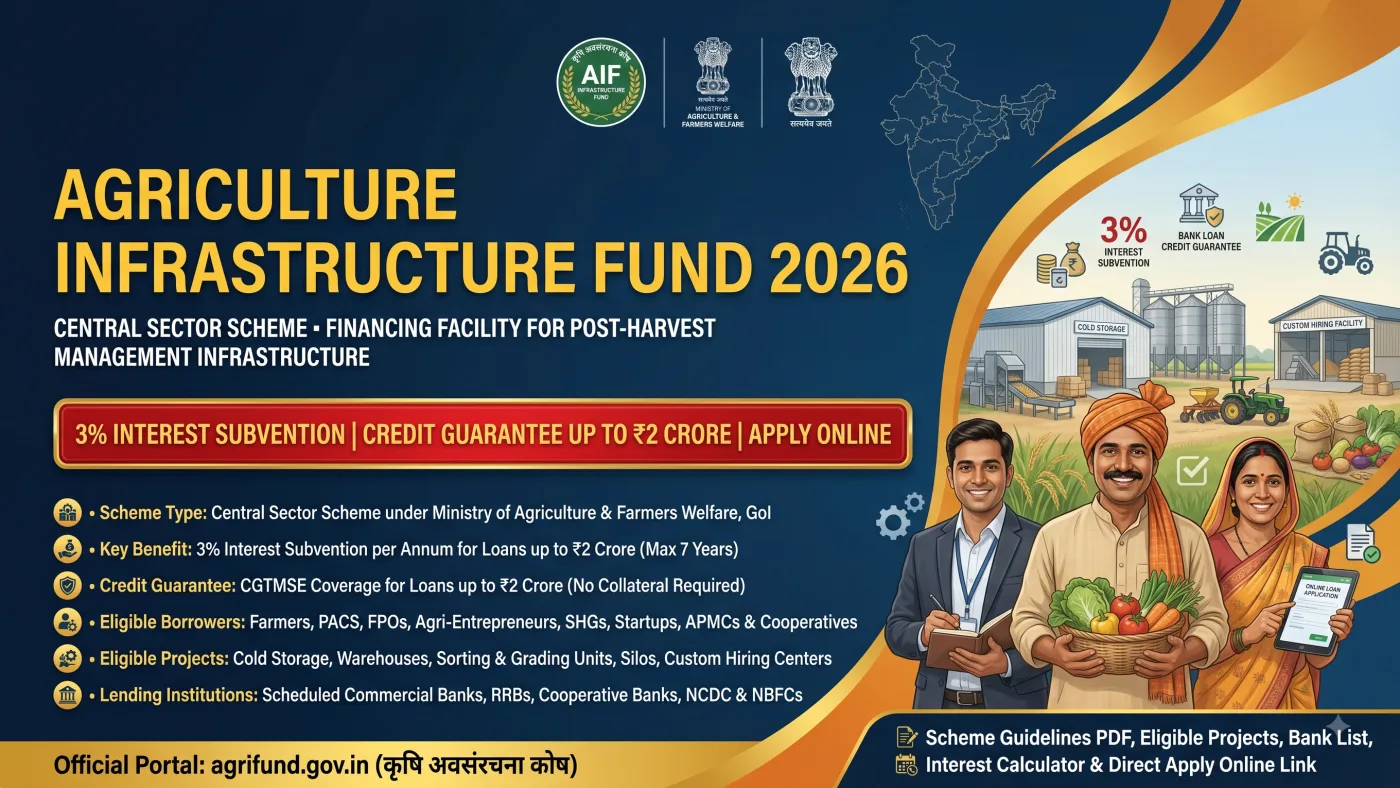
The Agriculture Infrastructure Fund 2026 (AIF, कृषि अवसंरचना कोष) is still running. On 30 September 2026 the Department of Agriculture & Farmers Welfare said the scheme is extended up to 31 March 2027, or until it is approved for the 16th Finance Commission period, whichever is earlier. AIF does not give a grant. It gives 3% interest subvention and a free CGTMSE guarantee on bank loans up to ₹2 crore for warehouses, cold stores, processing units and similar farm infrastructure.
Quick Summary (एक नज़र में)
| Point | Details |
|---|---|
| Scheme | Central Sector Scheme of Financing Facility under Agriculture Infrastructure Fund (AIF) |
| Run by | Department of Agriculture & Farmers Welfare (DA&FW), Ministry of Agriculture & Farmers Welfare |
| Main benefit | 3% per year interest subvention on loans up to ₹2 crore, for a maximum of 7 years |
| Interest rate cap | Lending rate capped at 9% for the subvention portion (so you pay about 6% on it) |
| Credit guarantee | CGTMSE cover for loans up to ₹2 crore; guarantee fee paid by the Government |
| Own contribution | Minimum 10% of the project cost |
| Repayment | Up to 7 years, including a moratorium of 6 months to 2 years |
| Capital subsidy | None under AIF (other schemes' subsidy can be added) |
| Current validity | Temporary extension up to 31 March 2027 or 16th FC approval, whichever is earlier |
| Apply at | agriinfra.dac.gov.in (Aadhaar e-KYC registration, free) |
AIF Status in 2026-27: What the 30 September 2026 Order Says
The AIF guidelines (revised September 2024) planned loan disbursement up to the end of 2025-26. Since then the scheme has been running on two short extensions:
- March 2026: the Department of Expenditure allowed AIF, along with PM-Kisan, PMFBY and other farm schemes, to continue till 30 September 2026 on the same terms.
- 30 September 2026 (OM No. R-11016/16/2020-I&P): AIF is extended up to 31 March 2027 or until the scheme is approved for the 16th Finance Commission period, whichever is earlier.
The September order keeps the same provisions, scope and cost norms. It also says that "no fresh approval/sanction of work is permitted from the 15th Finance Cycle (FC) period outlay", while payment of committed liabilities is allowed. The order does not explain how this affects new individual loan applications. Before you spend money on a DPR or land, ask the bank branch or your State PMU if new AIF loans are being sanctioned right now.
The scheme is still in active use. At the National Level Monitoring Committee meeting on 9 July 2026, the Ministry reported more than 2 lakh sanctioned projects, about 92% of the overall target. A nationwide campaign from 19 June to 20 July 2026 was held to invite applications and sanction loans.
How the 3% Interest Subvention Works: A Worked Example
The subvention is not paid to you in cash. Your bank claims it from the Ministry and credits it to your loan account. Three rules decide how much you save:
- Subvention is 3% a year, only on the outstanding loan up to ₹2 crore, and for a maximum of 7 years.
- The lending rate is capped at 9% for the subvention part (Ministry circular dated 31 August 2026).
- From that same circular, banks may claim subvention only on the outstanding principal. Processing fees, inspection charges, penal charges and interest on delayed payments do not count.
| Illustration (first year, before repayment starts) | Loan ₹1.5 crore | Loan ₹3 crore |
|---|---|---|
| Amount eligible for AIF benefit | ₹1.5 crore | ₹2 crore (cap) |
| Interest at 9% on eligible amount | ₹13.5 lakh | ₹18 lakh |
| 3% subvention credited by bank | ₹4.5 lakh | ₹6 lakh |
| Your effective rate on eligible amount | 6% | 6% |
| Remaining ₹1 crore | Not applicable | Bank's normal market rate, no subvention |
These figures are only an illustration. The real amount falls as you repay principal, and it depends on your bank's sanctioned rate and disbursement dates.
Who Can Take an AIF Loan
The portal lists these eligible entities:
- Individual farmers, Joint Liability Groups (JLGs), Self Help Groups (SHGs) and federations of SHGs
- Farmer Producer Organisations (FPOs) and federations of FPOs
- Primary Agricultural Credit Societies (PACS), marketing and multipurpose cooperative societies, and national and state federations of cooperatives
- Agri-entrepreneurs and start-ups
- Agricultural Produce Market Committees (APMCs / mandis) and state agencies
- Public-private partnership projects sponsored by Central, State or local bodies
- Community Level Federations (CLFs), added by the Ministry's letter dated 13 May 2025
PSUs cannot apply directly, but PPP projects they sponsor are eligible. Under the guidelines, 24% of the grant-in-aid is to be used for SC/ST entrepreneurs (16% SC, 8% ST). Banks are also asked to give priority to women and weaker sections.
The ₹2 crore limit is per location, not per person
A location means a village or town with its own LGD (Local Government Directory) code. Several projects in one village share a single ₹2 crore benefit limit. A project in a different village with a different LGD code gets its own ₹2 crore limit. Farmers, agri-entrepreneurs and start-ups can have at most 25 such projects. The 25-project cap does not apply to cooperatives, FPOs, SHG federations and state agencies. An APMC can get a separate ₹2 crore benefit for each different type of infrastructure in its market area.
Projects You Can and Cannot Finance
Eligible projects (examples from the guidelines)
- Warehouses, silos, cold stores, cold chain, pack houses, ripening chambers
- Sorting, grading, assaying and packaging units; reefer vans
- Primary processing: dal mill, flour mill, rice mill, oil ghani, cotton ginning, spice grinding
- Secondary processing integrated with primary processing (projects sanctioned on or after 29 August 2024)
- Custom Hiring Centre (minimum 4 machines or implements), drones, field sensors, precision farming
- Polyhouse, hydroponic, vertical, mushroom and aeroponic farming; nursery, tissue culture, seed processing
- Compressed biogas, vermicompost and bio-stimulant units; PM-KUSUM components A, B and C
Not eligible or restricted
- Working capital loans
- Standalone secondary processing (for example, only a biscuit or ketchup unit)
- Tractors and non-refrigerated vehicles for individual farmers (allowed for other entities)
- Activities shown as ineligible in the guidelines' crop table, such as alcoholic beverage making
- Direct loans to PSUs
AIF can be combined with subsidy schemes such as MIDH, PMFME, SMAM, PMKSY, AMI, RKVY, PM-KUSUM and the PMEGP Scheme 2026. A capital subsidy from these schemes counts as your own contribution. You must still put in at least 10% of the project cost yourself.
AIF is for building assets. For seasonal crop expenses, the right product is the Kisan Credit Card (KCC) Loan Scheme 2026, not AIF.
Documents Required for the AIF Loan
Based on the portal's checklist, keep these ready. Your bank may ask for more.
- Bank loan application form or a signed customer request letter for an AIF loan
- Passport-size photographs of the promoter, partners or directors
- Identity proof (Aadhaar, PAN, Voter ID or Driving Licence) and residence proof
- Business address proof, plus registration proof (partnership deed registration, company AoA, or Udyam / DIC certificate for MSMEs)
- Income Tax Returns and audited balance sheets for the last 3 years, if available; GST certificate, if applicable
- Land ownership or lease record for the project site
- Bank statement for the last one year and loan statements of existing loans
- Net worth statement of the promoter
- Detailed Project Report (DPR)
- Local permissions, layout plan, estimates and building sanction, where applicable
Making the DPR without paying a consultant
The portal's Model DPR page has free English and Hindi DPR templates. It also has ready model DPRs for common projects: warehouse, cold storage, solar cold rooms, rice mill, dal mill, flour mill, mustard oil unit, turmeric, chilli and spice processing, cashew unit, banana ripening chamber, custom hiring centre, drone pest spray, silo and reefer van. Your DPR can be in any format, but the FAQ says it must cover:
- the applicant's details and type of entity
- the process flow, raw material and end product
- the project cost break-up and means of finance
- plant and machinery
- revenue projections for 5 years
How to Apply for the Agriculture Infrastructure Fund Online
- Open agriinfra.dac.gov.in and click Beneficiary Corner → Register as Beneficiary.
- Complete Aadhaar e-KYC with your Aadhaar number and the mobile number linked to it. Your login details are created after OTP verification. Note down your Beneficiary ID.
- Log in with your Email or Beneficiary ID, Password and the Captcha.
- Fill the loan application. Choose the project type closest to your activity (or "Others" with a description), give the project location and select the lending institution and branch.
- Upload your DPR and submit. Beneficiary details cannot be edited by you after submission.
- The Central PMU checks the application. When it is verified, you get an SMS and the application goes automatically to the bank you selected.
- Visit the bank and finish its formalities. The bank appraises the project and decides whether to sanction it. The FAQ says sanction should normally take no more than 60 days.
- After disbursement, the bank claims the subvention and guarantee fee from the Ministry and credits the subvention to your loan account.
If the bank sits on your application
The circular dated 7 November 2024 gives a one-time option to switch banks. This applies if no credit decision is taken within 75 days of CPMU verification. The portal sends SMS reminders on the 76th, 80th and 85th day. Branch changes within the same bank are handled by that bank.
Mistakes That Delay AIF Applications
- Status shows "Pending Information": the PMU found missing or wrong details in the form or DPR. Read the PMU's remark, correct it and resubmit.
- Applying for working capital: it is not eligible, so keep it out of the AIF project cost.
- Splitting one site into several applications: projects in the same LGD location share one ₹2 crore benefit limit.
- Wrong name or details after submission: you cannot edit them. Email support.agriinfra@gov.in with the correction request.
- Bank says it does not know AIF: ask the branch to contact its AIF nodal officer, or call the helpline below.
- Bank charges above the cap: the cap is 9% for the subvention part. Note the rate on your sanction letter and raise a grievance if it is higher.
Safety note: registration on the AIF portal is free. Do not pay any agent who promises an "AIF subsidy" or guaranteed loan approval. Sanction depends only on the bank's appraisal of your project.
Official AIF Helpline Numbers
| Purpose | Phone | |
|---|---|---|
| Help and support | 011-23604902 | support.agriinfra@gov.in |
| DPR and application support | 011-23604958 | support.agriinfra@gov.in |
| Grievances | 011-23604924 | support.agriinfra@gov.in |
The helplines work Monday to Friday during office hours. The portal says requests are processed only through the email address above. For other credit-linked schemes, see all Government Loan Schemes.
Source: Agriculture Infrastructure Fund portal (agriinfra.dac.gov.in): Revised Scheme Guidelines September 2024; DA&FW OM No. R-11016/16/2020-I&P dated 30 September 2026 (temporary extension); Department of Expenditure OM F. No. 5(6)/PFC-I/2026 (March 2026); NLMC minutes of 9 July 2026 circulated on 21 July 2026; circular No. 1002-6/2026-AIF dated 31 August 2026; letter dated 13 May 2025 (CLFs); circular No. 1001/5/2023-AIF dated 7 November 2024; portal FAQs and document checklist. Last verified: 27 November 2026.
User Discussion & Comments (0)
No comments yet. Be the first to leave a comment below!
Leave a Comment / Ask a Question: