
1. Executive Scheme Overview & Grant Architecture (उत्तर प्रदेश गोपालक योजना का परिचय एवं डेयरी ऋण सब्सिडी ढांचा)
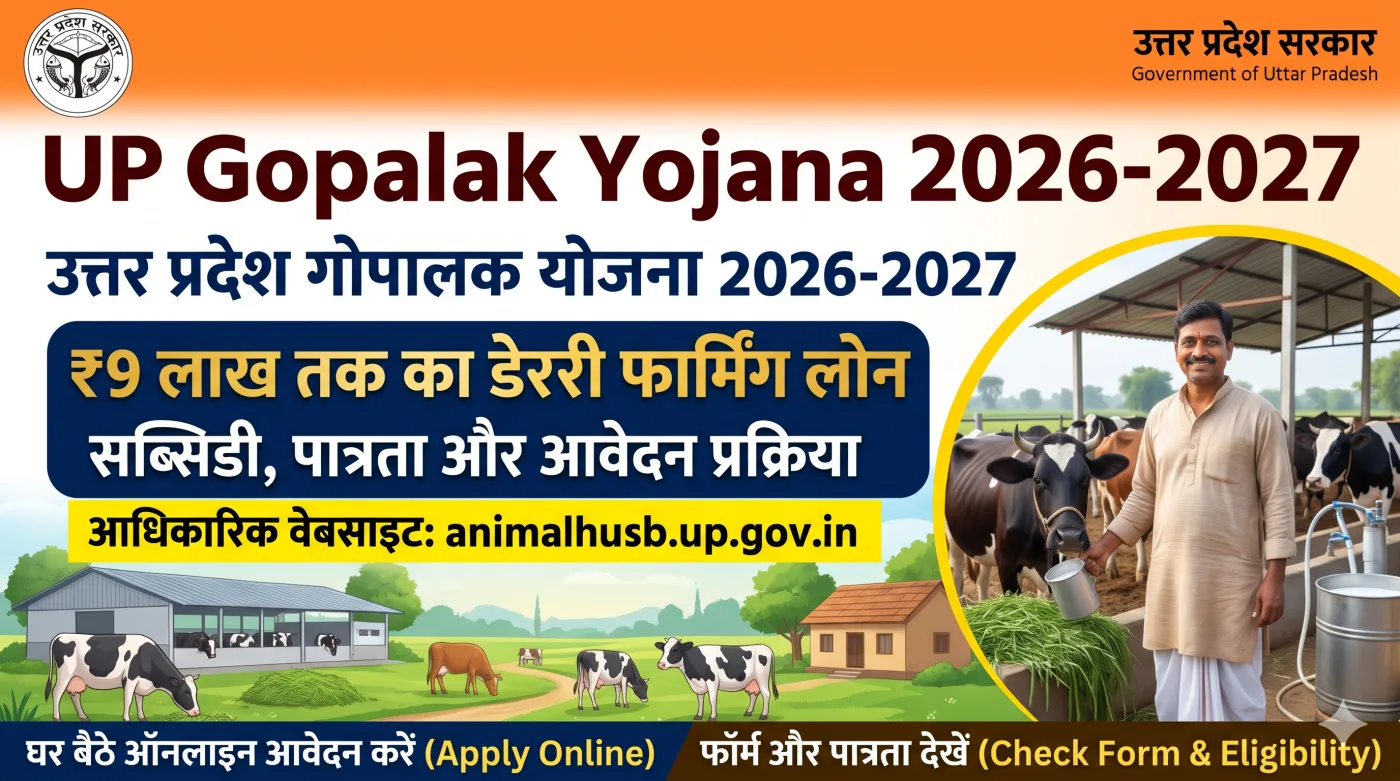
The UP Gopalak Yojana 2026-2027, administered under the visionary governance of the Animal Husbandry Department, Government of Uttar Pradesh (पशुपालन विभाग, उत्तर प्रदेश सरकार), represents one of Uttar Pradesh's most impactful social protection and empowerment initiatives. Formulated to provide universal social security, financial autonomy, and dignified living to rural and peri-urban unemployed youth, farmers, and traditional livestock keepers residing in Uttar Pradesh who wish to set up commercial dairy farms with 10 to 12 high-yielding indigenous cattle or buffaloes, this landmark program guarantees structured financial assistance and state-sponsored welfare grants of Bank Loan up to ₹9,00,000/- (₹9 Lakh) + ₹1,80,000/- Government Subsidy (₹40,000/Year for 5 Years) transferred directly into the verified savings bank accounts of beneficiaries via the Aadhaar Direct Benefit Transfer (DBT) payment gateway.
योजना का संक्षिप्त विवरण एवं उद्देश्य (Scheme Mission in Hindi): उत्तर प्रदेश के बेरोजगार युवाओं एवं किसानों को दुग्ध उत्पादन से जोड़कर आत्मनिर्भर बनाने तथा राज्य में श्वेत क्रांति को गति देने के उद्देश्य से 'गोपालक योजना' संचालित की जा रही है। इस योजना के अंतर्गत 10 से 12 दुधारू पशुओं (साहीवाल, गिर, थारपारकर गाय अथवा मुर्रा भैंस) की मिनी डेयरी स्थापित करने हेतु बैंकों के माध्यम से अधिकतम ₹9 लाख का ऋण उपलब्ध कराया जाता है। इसके साथ ही, राज्य सरकार द्वारा पशुपालक को ₹1.80 लाख की सब्सिडी प्रति वर्ष ₹40,000 की दर से सीधे बैंक खाते में प्रदान की जाती है।
Under the revised operational framework and enhanced budgetary allocations for the financial year 2026-2027, the Government of Uttar Pradesh has seamlessly integrated this scheme with the Public Financial Management System (PFMS) and the National Payments Corporation of India (NPCI) Aadhaar Payment Bridge (APB). This digital transformation guarantees that welfare disbursements are transferred without administrative delays, commission leakages, or physical intermediary bottlenecks. Over Over 38,000 Dairy Farms Established across 75 Districts across all 75 districts of Uttar Pradesh currently receive regular benefits through this automated welfare architecture.
This proactive welfare delivery model guarantees that state resources are distributed with complete equity and social justice. Every rupee allocated by the state legislature reaches the genuine beneficiary's account directly, fostering economic security, digital empowerment, and social dignity across rural and urban communities throughout Uttar Pradesh.
Enrollment under the scheme operates on a continuous, rolling basis throughout the calendar year via the official state portal at https://animalhusb.up.gov.in/. Applicants are not constrained by arbitrary seasonal application deadlines. Once approved by the competent district authority, the beneficiary remains entitled to structured state benefits, contingent upon completing mandatory annual verification and compliance protocols.
| Scheme Parameter | Official Policy Details (आधिकारिक योजना विवरण) |
|---|---|
| Scheme Title (योजना का नाम) | UP Gopalak Yojana 2026-2027 (उत्तर प्रदेश गोपालक योजना 2026-2027) |
| Administering Department (नोडल विभाग) | Animal Husbandry Department, Government of Uttar Pradesh (पशुपालन विभाग) |
| Target Beneficiary (लक्षित वर्ग) | rural and peri-urban unemployed youth, farmers, and traditional livestock keepers residing in Uttar Pradesh who wish to set up commercial dairy farms with 10 to 12 high-yielding indigenous cattle or buffaloes |
| Financial Benefit / Grant (वित्तीय सहायता) | Bank Loan up to ₹9,00,000/- (₹9 Lakh) + ₹1,80,000/- Government Subsidy (₹40,000/Year for 5 Years) |
| Payment / Benefit Mode (हस्तांतरण माध्यम) | Bank Credit Linkage + Annual Direct Benefit Transfer (DBT) Margin Subsidy into Bank Account |
| Rural Income Ceiling (ग्रामीण आय सीमा) | Annual Household Income up to ₹1,00,000/- per annum for priority subsidy clearance |
| Urban Income Ceiling (शहरी आय सीमा) | Open to All Rural and Semi-Urban Youth with Minimum 5 Animal Shed Space |
| Application Processing Cost (आवेदन शुल्क) | ₹0/- (Strictly Free of Cost on Official Portal) |
| Official Citizen Portal (आधिकारिक पोर्टल) | https://animalhusb.up.gov.in/ |
| District Sanctioning Authority (स्वीकृति अधिकारी) | Chief Veterinary Officer (CVO / मुख्य पशु चिकित्सा अधिकारी) & Financing Banks |
| Total Active Beneficiary Base | Over 38,000 Dairy Farms Established across 75 Districts |
| Key Verification Mechanism | Veterinary Medical Officer (VMO) On-Site Shed Inspection & Animal Tagging |
2. Historical Policy Evolution & Institutional Reforms (योजना का ऐतिहासिक सफर एवं विजन)
The institutional architecture of UP Gopalak Yojana 2026-2027 in Uttar Pradesh has undergone remarkable modernization over the past decade. Previously characterized by fragmented physical applications, manual record-keeping at block offices, and discretionary paper sanction files, the scheme often suffered from administrative backlogs and geographical exclusion in remote rural pockets of Purvanchal and Bundelkhand.
Under recent comprehensive governance reforms, the Government of Uttar Pradesh transitioned the entire workflow to a unified digital architecture. This systemic modernization introduced centralized online application submission, automated inter-departmental data validation against the e-District revenue database, digital signatures of sanctioning authorities, and electronic transmission of sanction orders directly to the state treasury.
नीतिगत सुधारों की मुख्य विशेषताएं (Key Policy Milestones in Hindi): पूर्ववर्ती कामधेनु योजना के सरलीकृत एवं सुलभ स्वरूप के रूप में गोपालक योजना को पुनर्गठित किया गया है। अब छोटे एवं सीमांत किसान भी मात्र 5 से 10 दुधारू पशुओं के साथ आसानी से डेयरी व्यवसाय प्रारंभ कर सकते हैं। पशुओं की ईयर टैगिंग (Ear Tagging) और राष्ट्रीय पशुधन मिशन (NLM) से एकीकरण के माध्यम से पारदर्शी बीमा एवं तकनीकी सहायता सुनिश्चित की गई है।
These landmark administrative enhancements have established absolute transparency in beneficiary selection. The elimination of physical intermediaries has empowered citizens, particularly women, elderly persons, and marginalized youth, to assert their statutory welfare rights directly through common digital touchpoints without paying unapproved facilitation charges.
3. Detailed Financial Benefits & Disbursement Matrix (वित्तीय ऋण सीमा, सरकारी सब्सिडी एवं पशु खरीद संरचना)
The financial architecture of UP Gopalak Yojana 2026-2027 is designed to deliver reliable, transparent, and timely fiscal support directly to beneficiaries. Depending on scheme specifications, benefits are disbursed either in structured quarterly cycles, milestone-based academic grants, or upfront capital subsidies linked with bank credit:
वित्तीय सहायता एवं भुगतान चक्र का विश्लेषण (Financial Breakdown in Hindi): योजना के अंतर्गत वित्तीय सहायता दो चरणों में प्रदान की जाती है ताकि पशुपालक पर अचानक कर्ज का बोझ न पड़े और दुग्ध उत्पादन चक्र निरंतर बना रहे:
| Installment / Stage | Eligible Timeline & Milestone | Scheduled Window | Amount / Benefit | Primary Purpose & Expenditure Heads |
|---|---|---|---|---|
| Phase 1: First 5 Cattle Purchase | Purchase of first batch of 5 high-yielding cows/buffaloes | Initial Disbursal | ₹4,50,000/- Bank Loan | Cattle procurement, livestock insurance, cattle shed preparation & initial fodder stock |
| Phase 2: Remaining 5 Cattle Purchase | Purchase of second batch of 5 cattle after 6 months | After 6 Months | ₹4,50,000/- Bank Loan | Ensures continuous milk supply during dry periods and steady daily cash flow |
| Total Composite Bank Loan | Full 10 to 12 Animals Commercial Unit | Total Project | ₹9,00,000/- (₹9 Lakh) | Combined bank credit for cattle acquisition, shed infrastructure & dairy equipment |
| Government Annual Subsidy | Disbursed annually upon successful physical inspection | Every 12 Months | ₹40,000/- Per Year | Direct Benefit Transfer subsidy to offset bank interest and fodder costs |
| Cumulative Total Subsidy Grant | Maximum 5 years operational compliance | Over 5 Years | ₹1,80,000/- Total Grant | 100% Non-repayable government financial grant credited directly into loan account |
Direct Benefit Transfer operates strictly through Aadhaar-based Electronic Benefit Transfer (EBT) protocols. The department transfers funds through the Reserve Bank of India (RBI) National Automated Clearing House (NACH). As a statutory safeguard, if a bank branch merges or changes its IFSC code, payments are not hindered provided the beneficiary's bank account remains mapped to the NPCI Aadhaar mapper.
Beneficiaries must verify that their savings account is classified as a single (individual) account rather than a joint account with non-eligible family members. The banking system automatically halts transactions if the account becomes dormant due to prolonged non-operational status; pensioners and beneficiaries are thus advised to conduct at least one small banking debit/credit every six months.
4. Division-Wise Target Allocations Across All 18 Administrative Divisions (उत्तर प्रदेश के 18 मंडलों में योजना का विस्तार)
To ensure equitable geographical distribution of welfare funds across Uttar Pradesh, the nodal department allocates statutory annual targets across all 18 administrative divisions, encompassing all 75 districts from the western industrial belt to the eastern agrarian districts:
| Administrative Division (मंडल) | Covered Districts (संबंधित जनपद) | Beneficiary Coverage / Allocation | Nodal District Supervisory Authority |
|---|---|---|---|
| Lucknow Division (लखनऊ) | Lucknow, Hardoi, Lakhimpur Kheri, Rae Bareli, Sitapur, Unnao | 12.5% State Allocation | Vikas Bhawan, Hazratganj / Nodal Officer Lucknow |
| Varanasi Division (वाराणसी) | Varanasi, Chandauli, Ghazipur, Jaunpur | 9.2% State Allocation | Vikas Bhawan, Kachehari / Nodal Officer Varanasi |
| Prayagraj Division (प्रयागराज) | Prayagraj, Fatehpur, Kaushambi, Pratapgarh | 8.8% State Allocation | Collectorate Complex / Nodal Officer Prayagraj |
| Gorakhpur Division (गोरखपुर) | Gorakhpur, Deoria, Kushinagar, Maharajganj | 9.5% State Allocation | Vikas Bhawan, Taramandal / Nodal Officer Gorakhpur |
| Kanpur Division (कानपुर) | Kanpur Nagar, Kanpur Dehat, Etawah, Farrukhabad, Kannauj, Auraiya | 8.6% State Allocation | Vikas Bhawan, Rawatpur / Nodal Officer Kanpur |
| Meerut Division (मेरठ) | Meerut, Baghpat, Bulandshahr, Gautam Buddha Nagar, Ghaziabad, Hapur | 8.4% State Allocation | Collectorate Compound / Nodal Officer Meerut |
| Agra Division (आगरा) | Agra, Firozabad, Mainpuri, Mathura | 7.1% State Allocation | Vikas Bhawan, Sanjay Place / Nodal Officer Agra |
| Bareilly Division (बरेली) | Bareilly, Badaun, Pilibhit, Shahjahanpur | 6.8% State Allocation | Vikas Bhawan, Civil Lines / Nodal Officer Bareilly |
| Ayodhya Division (अयोध्या) | Ayodhya, Ambedkar Nagar, Barabanki, Sultanpur, Amethi | 7.5% State Allocation | Collectorate / Nodal Officer Ayodhya |
| Moradabad Division (मुरादाबाद) | Moradabad, Bijnor, Rampur, Amroha, Sambhal | 5.9% State Allocation | Vikas Bhawan / Nodal Officer Moradabad |
| Aligarh Division (अलीगढ़) | Aligarh, Etah, Hathras, Kasganj | 4.8% State Allocation | Vikas Bhawan / Nodal Officer Aligarh |
| Saharanpur Division (सहारनपुर) | Saharanpur, Muzaffarnagar, Shamli | 4.6% State Allocation | Collectorate / Nodal Officer Saharanpur |
| Jhansi Division (झांसी) | Jhansi, Jalaun, Lalitpur | 3.8% State Allocation | Vikas Bhawan / Nodal Officer Jhansi |
| Chitrakoot Division (चित्रकूट) | Banda, Chitrakoot, Hamirpur, Mahoba | 3.6% State Allocation | Collectorate / Nodal Officer Banda |
| Devipatan Division (देवीपाटन) | Gonda, Bahraich, Balrampur, Shravasti | 5.4% State Allocation | Vikas Bhawan / Nodal Officer Gonda |
| Basti Division (बस्ती) | Basti, Sant Kabir Nagar, Siddharthnagar | 4.2% State Allocation | Vikas Bhawan / Nodal Officer Basti |
| Azamgarh Division (आजमगढ़) | Azamgarh, Ballia, Mau | 5.2% State Allocation | Collectorate / Nodal Officer Azamgarh |
| Mirzapur Division (मिर्ज़ापुर) | Mirzapur, Bhadohi, Sonbhadra | 3.9% State Allocation | Vikas Bhawan / Nodal Officer Mirzapur |
5. Comprehensive Eligibility Parameters & Exclusion Rules (पात्रता की शर्तें एवं पशुपालन मानक)
To ensure state resources reach genuinely deserving citizens, the Government of Uttar Pradesh enforces strict eligibility guidelines and exclusion criteria:
पात्रता के अनिवार्य मापदंड (Mandatory Eligibility Criteria in Hindi):
- आयु सीमा (Age Criteria): आवेदक की आयु आवेदन की तिथि को 18 से 55 वर्ष के मध्य होनी चाहिए।
- मूल निवास (UP Domicile): आवेदक उत्तर प्रदेश का स्थायी मूल निवासी होना अनिवार्य है।
- पशुशाला हेतु भूमि (Animal Shed Space): आवेदक के पास 10 से 12 दुधारू पशुओं के लिए पक्का या अर्ध-पक्का पशुबाड़ा (कैटल शेड) बनाने हेतु पर्याप्त निजी अथवा पट्टा भूमि उपलब्ध होनी चाहिए।
- प्रारंभिक पशु स्वामित्व (Initial Cattle Standard): आवेदक के पास कम से कम 5 दुधारू पशु रखने की प्रारंभिक व्यवस्था होनी चाहिए, जिसके बाद योजना के तहत 10-12 पशुओं की पूर्ण डेयरी इकाई स्वीकृत की जाती है।
- दुग्ध उत्पादन क्षमता (Milk Yield Criteria): खरीदी जाने वाली गाय कम से कम 10 लीटर प्रतिदिन तथा भैंस कम से कम 12 लीटर प्रतिदिन दूध देने की प्रमाणित क्षमता रखती हो।
- बैंक डिफ़ॉल्ट न होना (Clean Credit History): आवेदक किसी भी बैंक का पूर्व डिफ़ॉल्टर नहीं होना चाहिए तथा उसका क्रेडिट रिकॉर्ड स्वच्छ होना अनिवार्य है।
Disqualifications & Ineligibility Filters (अपात्रता के कारण)
Applications falling under any of the following parameters will be summarily rejected during scrutiny or field inquiry:
- Individuals below 18 years or above 55 years of age on the date of application submission.
- Applicants who do not possess suitable space or land for constructing livestock housing sheds.
- Defaulters of commercial banks, regional rural banks, or cooperative credit societies.
- Applicants who have already availed capital subsidies under Kamdhenu, Mini Kamdhenu, or Micro Kamdhenu schemes.
- Projects proposing non-descript low-yielding cattle breeds without veterinary health certification.
Inter-Departmental Data Triangulation & Anti-Fraud Verification (डेटा सत्यापन एवं धोखाधड़ी रोकथाम)
To prevent fraudulent claims and ensure fiscal probity, the Government of Uttar Pradesh employs an automated multi-layered data verification mechanism. Every incoming application is cross-referenced in real time against multiple state and central databases, including:
- Civil Registration System (CRS): For instantaneous verification of birth, death, and marital status records to eliminate counterfeit paper certificates.
- Income Tax Department Database (ITD): Real-time PAN-Aadhaar checks to ensure that neither the applicant nor disqualifying household members are income-tax assessees.
- EPFO & NPS Central Registry: Automated scanning to detect existing formal sector employment, employer provident fund contributions, or institutional pensions.
- Food & Civil Supplies (Ration Card Database): Cross-checking BPL, APL, and Antyodaya ration card category records and certified family tree structures.
Any applicant detected furnishing falsified claims is blacklisted from state welfare rosters, and recovery proceedings are initiated under the Revenue Recovery Act.
6. Mandatory Documents Checklist for Registration (आवश्यक प्रमाण पत्रों की संपूर्ण चेकलिस्ट)
Applicants must assemble all original statutory documents and create high-resolution digital copies within prescribed file-size thresholds prior to applying online:
| Required Document | Issuing Authority | File Format & Size | Critical Verification Standard |
|---|---|---|---|
| 1. Aadhaar Card & PAN Card of Applicant | UIDAI & Income Tax Department | PDF / JPG (Under 100 KB) | Identity and address proof mandatory for commercial dairy loan sanction |
| 2. Land Ownership / Lease Agreement for Cattle Shed | Revenue Department / Registered Lease Deed | PDF (Under 100 KB) | Proof of land availability for constructing cattle shed and fodder storage |
| 3. Bank Passbook Copy (बैंक पासबुक प्रति) | Any Scheduled Commercial / Regional Rural Bank in UP | PDF / JPG (Under 100 KB) | Active savings bank account passbook showing branch IFSC and account number |
| 4. UP Domicile / Residence Certificate (निवास प्रमाण पत्र) | Competent Tehsildar / Sub-Divisional Magistrate | PDF (Under 100 KB) | Proof of permanent resident status in Uttar Pradesh |
| 5. Income Certificate (आय प्रमाण पत्र) | Competent Tehsildar | PDF (Under 100 KB) | Mandatory for assessing household income and subsidy clearance priority |
| 6. Veterinary Medical Officer (VMO) Feasibility Report | Government Veterinary Hospital (पशु चिकित्सालय) | PDF (Under 100 KB) | Technical feasibility report certifying suitability of shed space and water supply |
| 7. Detailed Dairy Project Report (DPR / परियोजना रिपोर्ट) | Animal Husbandry Department / Self | PDF (Under 100 KB) | Detailed financial projection of milk yield, feed costs, and loan repayment |
| 8. Passport Size Color Photograph of Applicant | Recent Color Photograph | JPG / JPEG (Max 20 KB) | Clear frontal photograph taken against a light background |
Applicants must never submit photocopies of expired income certificates. Under current Uttar Pradesh revenue administration rules, income certificates carry a statutory validity of exactly 3 years from the date of digital issuance. If an applicant's income certificate has expired, a fresh certificate must be procured through the nearest Jan Seva Kendra (CSC) or citizen portal (edistrict.up.gov.in) before applying for the scheme.
दस्तावेज अपलोड करते समय तकनीकी सावधानियां (Technical Document Standards in Hindi): सभी प्रमाण पत्रों को स्कैनर द्वारा न्यूनतम 150 से 200 DPI रेजोल्यूशन पर स्कैन करें। पासपोर्ट फोटो का आकार 20 KB से अधिक नहीं होना चाहिए और फाइल एक्सटेंशन केवल .jpg या .jpeg होना चाहिए। अन्य सभी प्रमाण पत्र (आय, निवास, आयु, दिव्यांगता आदि) स्वच्छ पीडीएफ (.pdf) फॉर्मेट में होने चाहिए जिनका आकार 100 KB से कम होना अनिवार्य है। यदि फाइल साइज 100 KB से अधिक होगी, तो पोर्टल त्रुटि प्रदर्शित करेगा और फॉर्म सबमिट नहीं हो सकेगा।
7. Step-by-Step Online Application Walkthrough (ऑनलाइन एवं ऑफलाइन आवेदन की चरणबद्ध प्रक्रिया - A to Z गाइड)
The Government of Uttar Pradesh has established a streamlined, citizen-friendly online registration portal. Follow the comprehensive step-by-step walkthrough below:
ऑनलाइन आवेदन की संपूर्ण चरणबद्ध गाइड (Step-by-Step Guide in Hindi):
- Step 1: पशु चिकित्सालय में संपर्क करें (Visit Veterinary Hospital): अपने निकटतम राजकीय पशु चिकित्सालय (Government Veterinary Hospital) जाएं और पशु चिकित्सा अधिकारी (VMO) से मिलकर गोपालक योजना का आवेदन फॉर्म प्राप्त करें अथवा पोर्टल https://animalhusb.up.gov.in/ से डाउनलोड करें।
- Step 2: आवेदन फॉर्म भरें (Fill Application Form): फॉर्म में अपना व्यक्तिगत विवरण, पता, प्रस्तावित डेयरी का स्थान, पशुओं की संख्या (10-12 पशु), पसंदीदा नस्ल (साहीवाल, गिर, मुर्रा) तथा बैंक शाखा का नाम दर्ज करें।
- Step 3: आवश्यक दस्तावेज संलग्न करें (Attach Documents): आधार कार्ड, पैन कार्ड, निवास प्रमाण पत्र, आय प्रमाण पत्र, भूमि दस्तावेज तथा पशु शेड का नक्शा/फोटो फॉर्म के साथ संलग्न करें।
- Step 4: पशु चिकित्सा अधिकारी स्थलीय जांच (VMO Inspection): पशु चिकित्सा अधिकारी आपके स्थल का निरीक्षण करेंगे और पानी, बिजली तथा पशु आवास की तकनीकी उपयुक्तता प्रमाणित करते हुए अपनी रिपोर्ट फॉर्म पर दर्ज करेंगे।
- Step 5: मुख्य पशु चिकित्सा अधिकारी (CVO) को प्रेषण: पूर्ण रूप से भरा हुआ फॉर्म अपने जिले के मुख्य पशु चिकित्सा अधिकारी (CVO Office) में जमा करें।
- Step 6: जिला टास्क फोर्स एवं बैंक स्वीकृति (Taskforce & Bank Sanction): सीवीओ कार्यालय द्वारा आवेदन की जांच कर इसे संबंधित बैंक शाखा को ऋण स्वीकृति हेतु भेजा जाता है। बैंक द्वारा स्थल सत्यापन के बाद ऋण स्वीकृत किया जाता है।
- Step 7: पशु खरीद एवं सब्सिडी सक्रियण (Cattle Purchase & Subsidy): ऋण स्वीकृति के बाद पशुपालन विभाग की समिति की उपस्थिति में प्रमाणित दुधारू पशु खरीदे जाते हैं और उनकी ईयर टैगिंग कर वार्षिक सब्सिडी प्रक्रिया सक्रिय हो जाती है।
Once the initial online submission is completed, applicants are strongly advised to take the physical printout of the application form, attach self-attested photocopies of their Aadhaar Card, Income Certificate, Bank Passbook, and supporting records, and submit it to their respective block development office or tehsil office within 30 days to facilitate expedited field inquiry.
8. Offline Application & Doorstep Citizen Assistance Channels (ऑफलाइन आवेदन एवं ग्राम स्तरीय सहायता)
For citizens residing in remote rural hamlets who lack digital literacy, personal computers, or mobile smartphones, the Government of Uttar Pradesh has institutionalized robust grassroots facilitation mechanisms to ensure zero exclusion:
ग्राम सचिवालय एवं पंचायत सहायक के माध्यम से सहायता (Assistance at Gram Sachivalaya): उत्तर प्रदेश की प्रत्येक ग्राम पंचायत में स्थापित 'ग्राम सचिवालय' पर तैनात पंचायत सहायक (Panchayat Sahayak) को नागरिकों के ऑनलाइन आवेदन निःशुल्क भरने के स्पष्ट निर्देश दिए गए हैं। ग्रामीण अपने आवश्यक दस्तावेज लेकर ग्राम सचिवालय जाएं। पंचायत सहायक द्वारा बिना किसी शुल्क के फॉर्म ऑनलाइन भरकर पावती रसीद प्रदान की जाती है।
तहसील समाधान दिवस एवं संपूर्ण समाधान दिवस (Tehsil Diwas Escalation): प्रत्येक माह के प्रथम एवं तृतीय मंगलवार को आयोजित होने वाले 'संपूर्ण समाधान दिवस' में नागरिक सीधे उपजिलाधिकारी (SDM) अथवा तहसीलदार के समक्ष अपना प्रार्थना पत्र प्रस्तुत कर सकते हैं। समाधान दिवस में प्राप्त आवेदनों पर संबंधित अधिकारियों को 7 से 15 कार्यदिवसों के भीतर समयबद्ध जांच रिपोर्ट प्रस्तुत करनी होती है, जिससे योजना की स्वीकृति त्वरित गति से संभव होती है।
जन सेवा केंद्र (CSC / Jan Seva Kendra Network): राज्य भर में कार्यरत 1.5 लाख से अधिक कॉमन सर्विस सेंटर्स पर मामूली निर्धारित सरकारी शुल्क (₹20 से ₹30) देकर कोई भी नागरिक अपना फॉर्म भरवा सकता है और बायोमेट्रिक ई-केवाईसी करवा सकता है। किसी भी प्रकार की अवैध वसूली की शिकायत मिलने पर केंद्र संचालक का लाइसेंस रद्द किया जा सकता है।
विशेष शिविर एवं ग्राम चौपाल (Special Camps & Gram Chaupal): उत्तर प्रदेश सरकार द्वारा प्रत्येक शुक्रवार को ग्राम पंचायतों में 'ग्राम चौपाल' का आयोजन किया जाता है, जहाँ खंड विकास अधिकारी (BDO), सहायक विकास अधिकारी (ADO), और समाज कल्याण विभाग के प्रतिनिधि उपस्थित रहकर छूटे हुए पात्र लाभार्थियों के ऑन-द-स्पॉट फॉर्म भरवाते हैं।
9. Tracking Application Status & Multi-Tier Verification Hierarchy (आवेदन की स्थिति एवं मुख्य पशु चिकित्सा अधिकारी सत्यापन)
Beneficiaries can monitor their application progression online through the official dashboard. The scrutiny process navigates a transparent administrative hierarchy:
आवेदन की स्थिति जांचने की ऑनलाइन प्रक्रिया (Status Tracking in Hindi):
- आधिकारिक पोर्टल https://animalhusb.up.gov.in/ पर जाएं।
- होमपेज पर मौजूद 'आवेदन की स्थिति (Track Application Status)' लिंक पर क्लिक करें।
- अपना 12 अंकों का रजिस्ट्रेशन नंबर और पंजीकृत मोबाइल नंबर दर्ज करें।
- प्राप्त ओटीपी (OTP) तथा स्क्रीन पर प्रदर्शित कैप्चा कोड भरकर लॉगिन करें।
- डैशबोर्ड पर आवेदन की वर्तमान स्वीकृति स्थिति, जांच अधिकारी की टिप्पणी तथा आगामी भुगतान की स्थिति प्रदर्शित होगी।
| Verification Stage | Designated Officer | Scope of Investigation | Statutory Timeline |
|---|---|---|---|
| Stage 1: Grassroots Field Inquiry | Village Secretary (VDO) / Lekhpal / Field Inspector | Physical verification of address, income, eligibility criteria, and original documents | Within 15 Working Days |
| Stage 2: Block / Tehsil Scrutiny | Block Development Officer (BDO) / SDM | Scrutiny of field report and online endorsement on departmental portal | Within 10 Working Days |
| Stage 3: District Sanction Order | Chief Veterinary Officer (CVO / मुख्य पशु चिकित्सा अधिकारी) & Financing Banks | Final administrative and financial sanction of beneficiary account | Within 10 Working Days |
| Stage 4: State Treasury / PFMS Dispatch | State Treasury & Public Financial Management System | Generation of digital payment bill and transmission of funds via Aadhaar DBT | As per scheduled cycle |
Statutory Appellate Mechanism Against Application Rejection (अपील एवं पुनर्विचार प्रक्रिया)
If an applicant's registration is unjustly rejected at the field inquiry or block scrutiny level, the applicant has a statutory legal remedy under the administrative framework of Uttar Pradesh:
- First Appeal (प्रथम अपील): Within 30 days of receiving a rejection notice or online status update, the applicant may lodge a formal First Appeal before the Sub-Divisional Magistrate (SDM) / Chief Development Officer (CDO), citing the rejection remarks and attaching certified counter-evidence.
- Second Appeal / Revision (द्वितीय अपील): If the grievance remains unresolved, a Second Appeal can be submitted directly before the District Magistrate (DM / Collector) during the weekly public hearing days (जनता दर्शन) at the Collectorate.
- Departmental Inquiry: Upon receipt of an appeal, the District Magistrate has statutory authority to depute a senior administrative officer (such as SDM Sadar or Additional District Magistrate) to conduct an independent re-inquiry, overriding arbitrary field objections.
10. Annual Verification, Aadhaar e-KYC & Renewal Guidelines (वार्षिक पशु स्वास्थ्य निरीक्षण एवं सब्सिडी क्लीयरेंस गाइडलाइन्स)
To maintain absolute integrity in public expenditure, beneficiaries must comply with statutory periodic verification protocols:
सालाना प्रमाणीकरण एवं ई-केवाईसी के नियम (e-KYC Protocols in Hindi): राज्य सरकार के नियमों के अनुसार, पेंशन व कल्याणकारी योजनाओं के लाभार्थियों को प्रत्येक 12 माह में कम से कम एक बार अपना आधार प्रमाणीकरण (e-KYC) कराना अनिवार्य होता है। यदि ई-केवाईसी पूर्ण नहीं होता है, तो पीएफएमएस प्रणाली द्वारा आगामी किस्तों का भुगतान स्वतः रोक दिया जाता है। ई-केवाईसी पूर्ण होते ही रुकी हुई राशि पुनः जारी कर दी जाती है।
Two Methods to Complete Aadhaar e-KYC:
- Method 1: Smartphone OTP Verification: Log in to the official portal with registration details, navigate to Aadhaar Demographic Authentication, enter 12-digit Aadhaar, and authenticate via UIDAI OTP.
- Method 2: Biometric Fingerprint / Iris Verification at CSC: Visit any authorized Common Service Center for live biometric scanning using a fingerprint or iris scanner.
11. Grassroots Field Investigation & Panchayat Audit Protocol (स्थलीय सत्यापन एवं पंचायत जांच)
The credibility of Uttar Pradesh's welfare administration rests on rigorous physical verification conducted at the grassroots level. After registration, the digital application is routed automatically to the login portal of the field officer:
स्थलीय जांच के प्रमुख बिंदु (Key Points of Field Inquiry in Hindi): जांच अधिकारी आवेदक के पते पर व्यक्तिगत रूप से जाकर निम्नलिखित तथ्यों की पुष्टि करते हैं:
- भौतिक उपस्थिति (Physical Living Status): क्या आवेदक वास्तव में उसी ग्राम अथवा वार्ड का स्थायी निवासी है?
- आर्थिक एवं आय स्थिति (Income Verification): क्या आवेदक की वास्तविक पारिवारिक आय सरकार द्वारा निर्धारित सीमा के भीतर है?
- दस्तावेजों की प्रामाणिकता (Document Authenticity): मूल प्रमाण पत्रों का प्रत्यक्ष मिलान और पात्रता मानकों की संतुष्टि।
Following inquiry, the officer uploads a signed verification report on the portal. Any adverse finding is recorded with specific remarks, granting the applicant an opportunity to rectify discrepancies.
12. Social Audit & Public Transparency Mandate (सामाजिक अंकेक्षण एवं पारदर्शिता)
In compliance with governance mandates, Uttar Pradesh conducts bi-annual social audits through open Gram Sabha meetings on Republic Day (26th January) and Independence Day (15th August):
खुली बैठक में सामाजिक अंकेक्षण (Gram Sabha Social Audit in Hindi): ग्राम सचिवालय में ग्रामीणों की उपस्थिति में सभी पंजीकृत लाभार्थियों की सूची का वाचन किया जाता है। यदि किसी अपात्र व्यक्ति का नाम पाया जाता है, तो ग्रामीण मौके पर ही लिखित आपत्ति दर्ज करा सकते हैं। खुली बैठक के कार्यवृत्त के आधार पर अपात्रों के नाम हटाकर वास्तविक पात्र नागरिकों को जोड़ा जाता है।
13. Resolving Aadhaar-NPCI Bank Account Mapping & DBT Failures (बैंक ऋण वितरण, पशु बीमा एवं दुग्ध विपणन प्रबंधन)
A majority of payment disbursal failures result from banking misconfigurations rather than administrative cancellation. Direct Benefit Transfer requires active mapping on the NPCI payment gateway:
| PFMS Rejection Error Code | Underlying Technical Reason | Exact Citizen Action & Resolution Protocol |
|---|---|---|
| RJCT-01 / Inactive Aadhaar | Aadhaar number suspended or biometric de-activated in UIDAI database | Visit Aadhaar Seva Kendra, update biometrics/mobile number, and re-authenticate |
| RJCT-02 / Account Blocked / Dormant | Savings account rendered inoperative due to no transaction for over 12 months | Visit bank branch with KYC documents, deposit ₹100, and reactivate operative status |
| NPCI-ERR-03 / Not Mapped | Aadhaar linked to bank for KYC but not mapped to NPCI payment mapper | Submit physical NPCI Seeding Mandate Form to branch manager for APBS mapping |
| UIDAI-NAME-MISMATCH | Beneficiary name spelling in bank passbook differs from Aadhaar card | Get bank passbook name amended character-by-character to match Aadhaar card exactly |
| JOINT-ACC-REJECT | Bank account registered jointly with family member rather than single name | Open a new individual single savings account and update the nodal office with new passbook |
बैंक खाते में डीबीटी सक्रिय कराने के 4 आसान चरण (How to Enable DBT in Hindi):
- अपनी बैंक शाखा में जाएं और 'Aadhaar Seeding and NPCI Mapping Mandate Form' प्राप्त करें।
- फॉर्म में खाता संख्या, आधार नंबर भरें तथा 'Direct Benefit Transfer (DBT)' विकल्प पर टिक करें।
- बैंक के माइक्रो-एटीएम पर बायोमेट्रिक फिंगरप्रिंट लगाकर खाते को एनपीसीआई मैपर से सक्रिय कराएं।
- यूआईडीएआई अथवा मेरा आधार पोर्टल पर जाकर 'Bank Seeding Status' में पुष्टि करें कि खाता 'Active' दिख रहा है।
ऑनलाइन बैंक सीडिंग स्थिति जांचने का तरीका (Online Seeding Verification): नागरिक अपने मोबाइल अथवा कंप्यूटर पर यूआईडीएआई के MyAadhaar पोर्टल (myaadhaar.uidai.gov.in) पर जाएं, 'Bank Seeding Status' लिंक चुनें, अपना 12 अंकों का आधार नंबर तथा कैप्चा दर्ज कर ओटीपी से लॉगिन करें। स्क्रीन पर आपके आधार से जुड़े बैंक का नाम, मैपिंग की तिथि तथा स्थिति 'Active' प्रदर्शित होगी। यदि स्थिति 'Inactive' है, तो तुरंत अपनी संबंधित बैंक शाखा में संपर्क कर बायोमेट्रिक री-सीडिंग कराएं।
14. District Nodal Officers Directory & Grievance Channels (आधिकारिक संपर्क सूत्र एवं पशुपालन हेल्पलाइन)
Beneficiaries experiencing delays, portal errors, or non-disbursal of funds can access dedicated state grievance channels:
| Grievance Portal / Channel | Helpline Number / URL | Working Hours & Scope |
|---|---|---|
| Chief Minister Jan Sunwai Portal (जनसुनवाई) | https://jansunwai.up.gov.in/ | 24x7 Online Grievance Lodging with mandatory 14-day resolution tracking |
| CM Helpline Toll-Free Number | Dial: 1076 (Toll-Free Pan-UP) | 24 Hours Citizen Call Center for direct registration of complaints |
| Departmental Helpline Toll-Free | 1800-180-5145 / 0522-2740482 | Official State Department Helpline (10:00 AM to 5:00 PM on working days) |
| District Nodal Office | Located at Collectorate / Vikas Bhawan of all 75 Districts | Personal visit on public hearing days (Monday to Friday, 10:00 AM to 1:00 PM) |
| Departmental Official Email | support.animalhusb@up.gov.in | Official email support for technical and registration grievances |
15. Comparative Matrix with Related Schemes in Uttar Pradesh (गोपालक योजना बनाम कामधेनु योजना का तुलनात्मक विश्लेषण)
To assist citizens in selecting the appropriate welfare intervention, the table below compares UP Gopalak Yojana 2026-2027 with related state schemes:
| Feature Parameter | UP Gopalak Yojana 2026-2027 | Mini Kamdhenu Yojana | Kisan Credit Card (Animal Husbandry) |
|---|---|---|---|
| Required Cattle Herd Size | 10 to 12 Milking Cattle | 25 to 50 High-Yield Cattle | 1 to 4 Cattle Units |
| Total Project Cost / Loan | Up to ₹9,00,000/- (₹9 Lakh) | ₹25 Lakh to ₹50 Lakh | Up to ₹2,00,000/- (₹2 Lakh) |
| Direct Government Subsidy | ₹1,80,000/- (₹40,000/Year for 5 Years) | Interest Subvention Subsidy | Interest Subvention at 3% |
| Land & Shed Requirement | Modest Land for 10 Animals | Large Commercial 1-2 Acre Farm | Existing Household Cattle Shed |
| Target Beneficiary Base | Small & Marginal Farmers, Rural Youth | Large Commercial Investors | Small Dairy Farmers |
| Administering Authority | Chief Veterinary Officer (CVO) UP | State Level Dairy Committee | Lead District Bank (LDM) & CVO |
16. Critical Mistakes to Avoid During Application & Verification (आवेदन करते समय इन 7 गलतियों से बचें)
Over 18% of initial scheme applications face procedural delays or rejections due to preventable administrative mistakes. Applicants should strictly adhere to these guidelines:
- Name Spelling Discrepancy (नाम में अंतर): Ensure that the applicant's name on the application form matches character-by-character with the Aadhaar Card and Bank Passbook. A single letter mismatch will cause automated rejection by PFMS.
- Expired Income Certificate (पुराना आय प्रमाण पत्र): Submitting an income certificate older than 3 years is a primary cause of rejection. Always ensure that the certificate is currently active and verifiable on the e-District UP portal.
- Joint Bank Account with Family Member (संयुक्त खाता): Welfare rules strictly mandate an individual single savings account in the beneficiary's own name. Joint accounts held with relatives are rejected by the payment gateway.
- Unregistered Mobile Number (मोबाइल नंबर की समस्या): Always enter an operative mobile number that remains active. OTPs for verification and SMS alerts for DBT credits are dispatched to this registered number.
- Failure to Submit Physical Documents at Office (हार्ड कॉपी जमा न करना): In many rural blocks, field inquiry begins only after receiving the physical docket. Submitting the printed form with self-attested photocopies ensures speedier processing.
- Mismatch in Family ID / Ration Card (पारिवारिक विवरण में अंतर): Ensure that the family head and relationship records in the Parivar Register or Ration Card align precisely with the self-declaration submitted on the portal.
- Submitting Blurred or Low-Resolution Scans (धुंधले दस्तावेज अपलोड करना): Scanning photocopies on mobile cameras often results in unreadable documents. Always upload 200 DPI scans made on flatbed scanners to prevent outright rejection by the scrutiny clerk.
17. Legal Rights & Statutory Protections Under Uttar Pradesh Welfare Acts (उत्तर प्रदेश गो-संरक्षण एवं पशु संवर्धन अधिनियम के तहत अधिकार)
Beneficiaries of welfare schemes in Uttar Pradesh are protected under statutory state and national legal frameworks. Under the Uttar Pradesh Right to Public Services Act (उत्तर प्रदेश जनहित गारंटी अधिनियम), designated public authorities are statutorily bound to deliver services within notified timeframes. If an application is withheld beyond the prescribed timeline without valid cause, the applicant has the legal right to file an appeal before the designated Appellate Authority.
Furthermore, under the legal aid provisions of the National Legal Services Authority (NALSA) and the UP State Legal Services Authority (UPSLSA), impoverished citizens, women, senior citizens, and persons with disabilities are entitled to 100% free legal assistance through District Legal Services Authorities (DLSA) established at every district court across Uttar Pradesh.
राष्ट्रीय लोक अदालत एवं त्वरित समाधान (Lok Adalat Settlement): यदि किसी पेंशनभोगी अथवा लाभार्थी का खाता तकनीकी कारणों से महीनों से लंबित है अथवा बैंक द्वारा आधार सीडिंग करने में आनाकानी की जा रही है, तो प्रत्येक त्रैमास में आयोजित होने वाली 'राष्ट्रीय लोक अदालत (National Lok Adalat)' में सीधे प्रार्थना पत्र देकर बैंक अधिकारियों एवं विभागीय अधिकारियों की उपस्थिति में उसी दिन मामले का अंतिम निस्तारण कराया जा सकता है।
18. Official Government Orders (GOs) & Administrative Circular Directory (शासनादेश एवं प्रशासनिक परिपत्र निर्देशिका)
The execution of UP Gopalak Yojana 2026-2027 is governed by binding Government Orders (GOs / शासनादेश) issued by the Government of Uttar Pradesh:
| Government Order (GO) Reference | Promulgation Date | Core Policy Mandate & Administrative Directive |
|---|---|---|
| GO No. 418/2019/Pashupalan-Gopalak-Rules | 12 June 2019 | Official promulgation of restructured UP Gopalak Yojana offering ₹9 Lakh loan and ₹1.80 Lakh subsidy |
| GO No. 92/2021/Animal-Husb-EarTagging | 14 September 2021 | Mandatory integration of INAF digital ear tagging and livestock insurance for all subsidized dairy animals |
| GO No. 138/2022/CVO-Disbursal-Timeline | 08 December 2022 | Time-bound 21-day mandate for veterinary officers to process technical feasibility inspections |
| GO No. 54/2024/Subsidy-DBT-Streamlining | 19 April 2024 | Direct treasury disbursement of ₹40,000 annual subsidy tranche into beneficiaries Aadhaar-seeded accounts |
| GO No. 11/2025/Desi-Cow-Breed-Incentive | 06 January 2025 | Special incentive package for dairy farmers preserving indigenous high-yield breeds (Sahiwal, Gir, Tharparkar) |
Citizens confronting administrative non-compliance can cite these official government circulars when lodging appeals before the District Magistrate (DM) or departmental supervisory officers, ensuring transparent and accountable execution of welfare programs across Uttar Pradesh. All cited Government Orders represent statutorily binding administrative directives published in the official Gazette of Uttar Pradesh, and administrative non-compliance or arbitrary denial of notified entitlements is justiciable before the Hon'ble High Court of Judicature at Allahabad and its Lucknow Bench under Article 226 of the Constitution of India.
19. Digital Governance, AI Verification & Future Welfare Roadmap (डिजिटल सुशासन एवं भावी कल्याणकारी रूपरेखा)
Under the Digital Uttar Pradesh Mission, the Government of Uttar Pradesh is deploying cutting-edge digital governance systems across all welfare schemes. Key initiatives include the integration of artificial intelligence for automated document OCR scanning, robotic process automation (RPA) for rapid application indexing, and cross-verification against the Civil Registration System (CRS) for real-time life status updates.
Furthermore, the state administration is expanding the integration of the UP Family ID (परिवार पहचान पत्र - Ek Parivar Ek Pehchan) repository with the welfare database. Through this unified family registry, eligible beneficiaries living in verified BPL and Antyodaya households can be proactively identified and extended welfare entitlements with zero administrative friction, cementing Uttar Pradesh's leadership in citizen-centric digital governance and inclusive social security delivery.
पारदर्शिता और सुशासन का नया मॉडल (Citizen-Centric Social Security): राज्य सरकार का स्पष्ट संकल्प है कि किसी भी वास्तविक जरूरतमंद, असहाय बुजुर्ग, दिव्यांग, विधवा अथवा गरीब विद्यार्थी को सरकारी सहायता प्राप्त करने में कोई असुविधा न हो। 'ई-पेंशन', 'ई-डिस्ट्रिक्ट' और 'सीएम जनसुनवाई' का त्रिकोणीय समन्वय यह सुनिश्चित करता है कि योजना का लाभ समय पर, सीधे लाभार्थी के बैंक खाते में बिना किसी बिचौलिए के पहुंचे।
User Discussion & Comments (0)
No comments yet. Be the first to leave a comment below!
Leave a Comment / Ask a Question: